
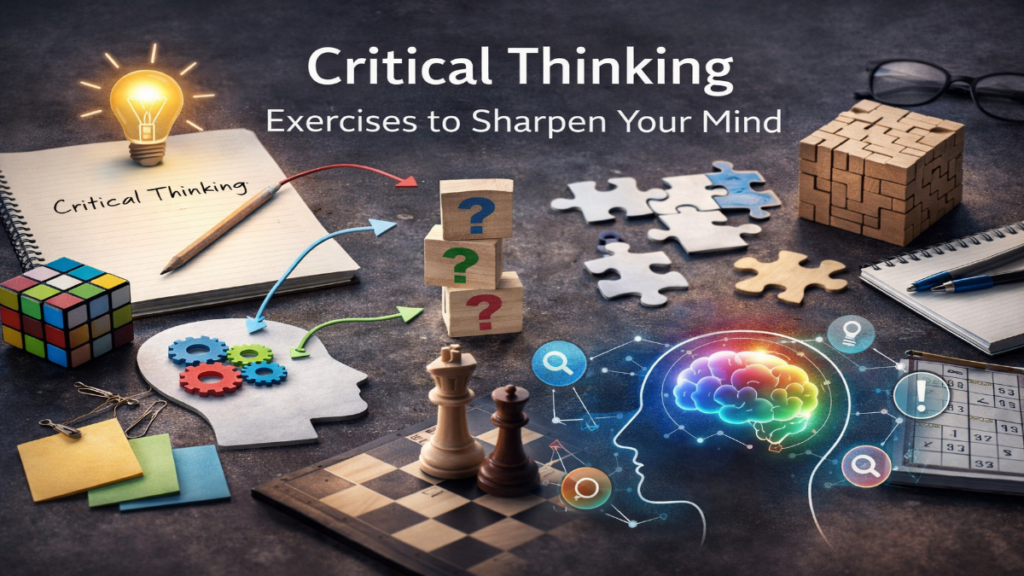

In classrooms, boardrooms, and daily conversations, the ability to evaluate information critically has become a defining skill of the modern age. Critical thinking exercises—structured mental practices designed to sharpen reasoning and judgment—are increasingly recommended by educators, psychologists, and employers. At their core, these exercises train the brain to analyze evidence, recognize bias, and approach problems with disciplined skepticism.
The value of critical thinking has become especially clear in an era defined by information overload. Social media feeds, algorithm-driven news, and generative artificial intelligence have made it easier than ever to encounter persuasive but misleading claims. Exercises that strengthen reasoning skills help people distinguish fact from opinion, question assumptions, and reach more informed conclusions.
Educators often describe critical thinking not as an innate talent but as a habit developed through practice. Studies of learning environments—from university courses to professional training programs—show that structured activities like debate, reflective writing, and case-study analysis can significantly improve students’ analytical abilities and decision-making skills. When people deliberately examine their assumptions, analyze arguments, and test alternative perspectives, they strengthen neural pathways associated with reasoning and memory.
At its most practical level, critical thinking training is simply mental exercise. Like physical fitness, cognitive strength develops through repeated challenge. A daily habit of questioning evidence, mapping arguments, or reflecting on past decisions gradually transforms how individuals interpret the world around them. The result is not only sharper intellect but also a deeper capacity for curiosity, humility, and thoughtful judgment.
The Science Behind Critical Thinking
Critical thinking involves several cognitive processes: analysis, evaluation, inference, and self-reflection. Psychologists often describe it as “metacognition,” or the ability to think about one’s own thinking. When individuals examine the reliability of information or reconsider a personal belief, they are practicing metacognitive awareness.
Research in education consistently shows that structured learning activities can improve these abilities. A quasi-experimental study examining university courses found that students exposed to dedicated critical-thinking modules significantly improved their ability to present evidence, evaluate assumptions, and draw systematic conclusions. These gains suggest that reasoning skills are not fixed traits but competencies strengthened through deliberate practice.
Critical thinking also reinforces broader learning outcomes. Studies of reading comprehension show that students trained in questioning techniques and argument analysis become better at distinguishing fact from opinion and evaluating evidence. This deeper engagement leads to improved understanding of complex texts and stronger academic performance.
Dr. Diane Halpern, a psychologist known for her research on reasoning, once wrote: “Critical thinking is purposeful, reasoned, and goal-directed thinking.” The implication is clear: thinking critically requires conscious effort.
The practical consequence is that cognitive training matters. Exercises that challenge assumptions or demand evidence-based reasoning encourage individuals to slow down their mental processes and engage analytical systems in the brain. Over time, this habit improves not only academic learning but also everyday decision-making.
Why Critical Thinking Matters More Than Ever
The digital age has amplified the importance of disciplined reasoning. In the past, information scarcity limited the number of competing claims people encountered. Today the opposite problem exists: an overwhelming abundance of information, some reliable and some misleading.
The ability to evaluate evidence is therefore essential for navigating modern life. Critical thinkers tend to question sources, analyze arguments, and recognize bias before forming conclusions. This skepticism protects individuals from misinformation and manipulation.
A growing body of research also links critical thinking with creativity and innovation. When people challenge assumptions and consider multiple perspectives, they are more likely to generate novel ideas and solutions. Employers increasingly emphasize these abilities in hiring decisions.
In fact, many workplace leaders see reasoning skills as essential for the knowledge economy. Employees who analyze problems carefully and evaluate evidence before acting tend to make better strategic decisions. These capabilities translate into improved performance across industries, from engineering to public policy.
However, new technologies are complicating the picture. A recent study involving essay writing tasks found that participants who relied heavily on AI-generated responses showed lower cognitive engagement than those writing independently or using traditional search tools. The findings raised questions about whether automated assistance might reduce opportunities for active reasoning. While the research remains ongoing, it highlights the importance of maintaining deliberate thinking habits even in technologically advanced environments.
Common Types of Critical Thinking Exercises
Critical thinking exercises vary widely, but most fall into a few recognizable categories. Each type trains a different dimension of reasoning.
| Exercise Type | Description | Key Skill Developed |
|---|---|---|
| Reflective Journaling | Writing about decisions, beliefs, or experiences to analyze assumptions | Self-awareness |
| Debate and Argumentation | Structured discussions defending opposing viewpoints | Logical reasoning |
| Case Study Analysis | Evaluating real-world scenarios to propose solutions | Problem solving |
| Fact vs. Opinion Sorting | Identifying evidence versus interpretation | Information literacy |
| Brain Teasers and Puzzles | Solving logical or strategic problems | Analytical reasoning |
Reflective writing exercises, for example, encourage individuals to examine past decisions and identify underlying assumptions. By revisiting choices and evaluating outcomes, people develop greater awareness of cognitive biases and reasoning errors.
Debate exercises train individuals to defend a position with evidence while also understanding opposing perspectives. The process forces participants to articulate arguments clearly and evaluate the strength of competing claims.
Another common exercise involves distinguishing factual statements from opinions in news articles or online posts. This activity strengthens media literacy and helps participants recognize persuasive language and unsupported assertions.
Together, these practices build a toolkit of reasoning strategies that individuals can apply in everyday situations.
Reflective Writing: Thinking Through Experience
Among the most widely recommended critical thinking exercises is reflective journaling. The activity appears deceptively simple: write regularly about decisions, experiences, or beliefs and analyze them carefully.
Yet the process activates several key cognitive mechanisms. When individuals revisit a decision—such as a career choice or financial investment—they examine the reasoning that led to it. They identify assumptions, biases, and gaps in evidence that may have influenced the outcome.
Educational researchers frequently incorporate reflective writing into learning environments because it encourages metacognition. Students are asked not only what they learned but also how they learned it. This introspective process deepens understanding and reveals areas where reasoning may need improvement.
For professionals, reflective writing can also serve as a decision-making tool. Managers sometimes document strategic choices and revisit them later to evaluate outcomes. By comparing initial assumptions with real-world results, they develop stronger analytical judgment over time.
As one education scholar noted, reflection is “a cornerstone of learning,” linking knowledge with thoughtful evaluation of experience. The habit transforms everyday events into opportunities for cognitive growth.
Debate and Perspective-Taking
Debate exercises represent another powerful method for strengthening reasoning. In structured debates, participants are assigned opposing positions and must defend them using evidence and logical argument.
The format forces individuals to confront viewpoints that challenge their own assumptions. Even when participants personally disagree with a position, they must research supporting evidence and articulate persuasive arguments.
This exercise develops intellectual flexibility. By examining multiple perspectives, participants learn that complex issues rarely have simple answers. Instead, thoughtful reasoning requires weighing competing evidence and evaluating trade-offs.
Role-playing scenarios extend this concept further. Participants assume the perspectives of stakeholders in ethical dilemmas—such as policymakers debating environmental regulation or journalists assessing controversial information. These activities encourage empathy while sharpening analytical skills.
Structured debate formats, including “philosophical chairs” and pro-con discussions, are widely used in classrooms because they combine reasoning with communication practice. Participants must not only analyze evidence but also express their conclusions clearly and persuasively.
The result is a deeper understanding of how arguments are constructed—and how they can be evaluated critically.
Analytical Games and Puzzles
While debates and writing exercises emphasize reasoning and reflection, analytical games target problem-solving skills. Logic puzzles, strategy games, and pattern-recognition challenges stimulate analytical thinking by forcing individuals to identify relationships between pieces of information.
Classic examples include Sudoku, chess, and mathematical puzzles. These games require players to anticipate consequences, test hypotheses, and revise strategies when assumptions prove incorrect.
Research on cognitive training suggests that such activities strengthen working memory and attention to detail. When individuals repeatedly practice identifying patterns and testing solutions, they develop mental habits useful for complex problem solving.
Puzzle-based exercises also encourage persistence. Many challenges cannot be solved immediately; players must experiment with different approaches before finding a solution. This iterative process mirrors the analytical reasoning used in scientific inquiry and engineering.
Importantly, puzzles also provide a low-stakes environment for experimentation. Players can test ideas without significant consequences, making the exercise both engaging and educational.
Comparing Popular Critical Thinking Activities
Different exercises emphasize distinct cognitive abilities. Understanding their strengths helps educators design balanced training programs.
| Exercise | Primary Skill | Typical Setting | Difficulty Level |
|---|---|---|---|
| Journaling | Reflection and bias awareness | Personal learning | Low |
| Debate | Argument evaluation | Classroom or workshop | Medium |
| Case Studies | Real-world problem solving | Business or academic training | Medium |
| Logic Puzzles | Analytical reasoning | Individual practice | Low–Medium |
| Research Verification | Source evaluation | Media literacy training | Medium–High |
Balanced training often combines several of these methods. For example, a university seminar might include case studies, debates, and reflective essays within the same course.
The diversity of exercises reflects the complexity of critical thinking itself. Reasoning skills involve multiple cognitive processes—analysis, evaluation, synthesis, and reflection—each strengthened through different activities.
Expert Perspectives on Training the Mind
Many scholars emphasize that critical thinking must be practiced intentionally.
“Students rarely develop strong reasoning skills simply by absorbing information,” wrote education researcher Peter Facione, whose work on critical thinking assessment has influenced curricula worldwide. “They must actively analyze arguments and test their own assumptions.”
Psychologist Daniel Willingham, known for his research on cognition and education, argues that knowledge and critical thinking are deeply connected. “You can’t think critically about something you don’t know much about,” he wrote, emphasizing that expertise and reasoning skills develop together.
Another influential voice, cognitive scientist John Dewey, described reflective thinking as a process of “active, persistent, and careful consideration.” Dewey’s early twentieth-century writings continue to shape modern educational philosophy, particularly the idea that learning occurs through inquiry rather than passive memorization.
These perspectives share a common theme: reasoning improves when individuals engage actively with ideas rather than merely consuming information.
Critical Thinking in the Age of Artificial Intelligence
The rise of generative AI has sparked new debates about the future of human reasoning. On one hand, intelligent systems can provide instant summaries, explanations, and analysis—potentially supporting learning and research.
On the other hand, researchers warn that overreliance on automated answers could weaken independent thinking. In experimental settings, participants who relied heavily on AI-generated essays demonstrated lower levels of neural engagement compared with those who wrote independently.
Some scholars propose integrating AI into learning environments in ways that stimulate reasoning rather than replace it. For example, systems might present counterarguments or prompt users to justify conclusions, encouraging active reflection.
Recent research exploring “provocation prompts”—short critiques embedded in AI responses—suggests that these interventions can stimulate metacognitive thinking and encourage users to evaluate automated suggestions more carefully.
The broader lesson is clear: technology can support critical thinking, but only if individuals remain actively engaged in evaluating information.
Takeaways
- Critical thinking exercises strengthen reasoning by training individuals to analyze evidence, question assumptions, and evaluate arguments.
- Structured activities such as debate, journaling, and case studies significantly improve analytical skills in educational research.
- Reflective practices help individuals recognize cognitive biases and improve decision-making over time.
- Analytical puzzles and games strengthen pattern recognition, persistence, and logical reasoning.
- In the digital age, critical thinking is essential for identifying misinformation and evaluating sources.
- Emerging technologies like AI can support learning but require careful use to maintain active reasoning.
Conclusion
Critical thinking is often described as a skill, but in practice it resembles a discipline—a habit of mind cultivated through regular exercise. Like physical fitness, intellectual strength grows gradually through consistent challenge. Each time individuals question a claim, analyze evidence, or reconsider a belief, they strengthen cognitive pathways that support thoughtful judgment.
The importance of this discipline has never been greater. Modern societies are saturated with information, persuasion, and competing narratives. Navigating that complexity requires more than knowledge; it requires the ability to evaluate knowledge critically.
Fortunately, the tools for developing these abilities are accessible to anyone. Reflective writing, structured debate, analytical puzzles, and evidence-based discussion all provide opportunities to sharpen reasoning. In classrooms, workplaces, and personal life, these exercises transform passive consumption of information into active inquiry.
Ultimately, critical thinking is less about winning arguments than about understanding the world more clearly. It is the practice of curiosity guided by evidence—a habit that equips individuals to face uncertainty with insight rather than impulse.
Click Here For More Blog Posts!
FAQs
What are critical thinking exercises?
They are structured activities designed to strengthen reasoning skills. Examples include debate, reflective journaling, logic puzzles, and case-study analysis. These exercises train individuals to evaluate evidence and question assumptions.
How often should you practice critical thinking exercises?
Even short daily practices—such as analyzing news sources or solving logic puzzles—can improve reasoning over time. Consistency matters more than duration.
Do critical thinking exercises improve academic performance?
Research suggests they do. Studies show that students trained in analytical questioning and argument evaluation often demonstrate stronger reading comprehension and problem-solving abilities.
Are puzzles effective for developing critical thinking?
Yes. Logical puzzles and strategy games strengthen analytical reasoning, pattern recognition, and persistence—skills closely related to critical thinking.
Can technology help develop critical thinking?
Technology can support reasoning through research tools and interactive learning platforms. However, individuals must remain actively engaged rather than relying solely on automated answers.