
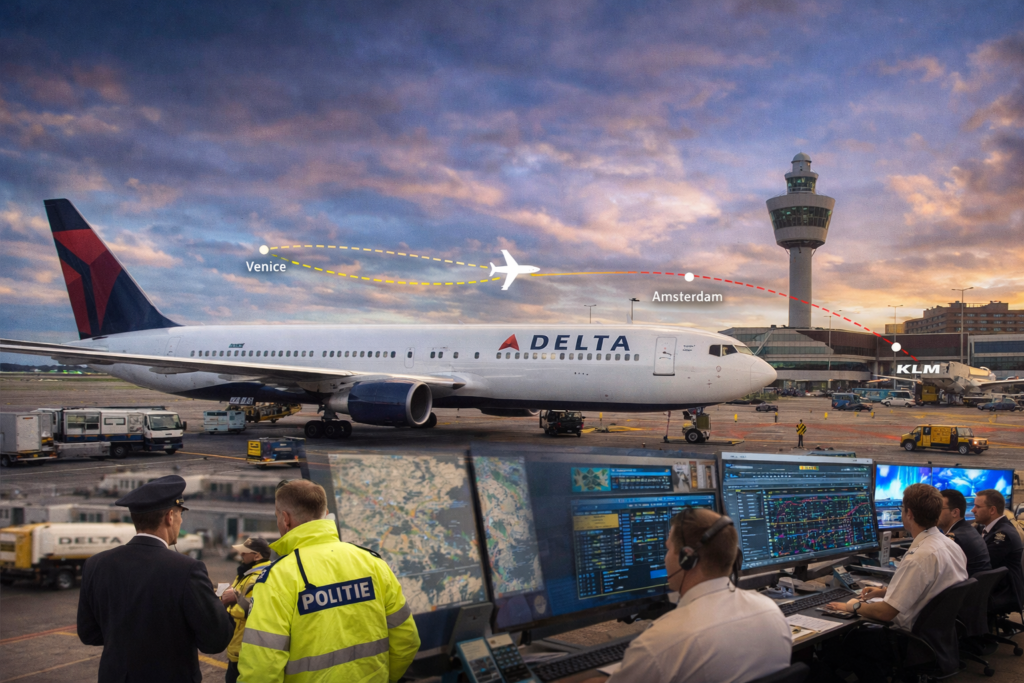

Transatlantic aviation is built on the fiction of routine. Passengers boarding a 767 in Venice expect a 10-hour arc ending in Atlanta’s humidity. That expectation is the product of millions of successful flights, rigorous procedures, and the quiet competence of crews trained to handle exactly what happened on the morning of June 30, 2025 Delta DL139 Venice Atlanta Diversion Amsterdam.
Delta Air Lines flight DL139 departed Venice Marco Polo Airport bound for Hartsfield-Jackson Atlanta International Airport. A little more than one hour into the flight, the crew decided to change course. The Boeing 767-400ER registered N830MH headed for Amsterdam Schiphol, landing on runway 06 approximately 95 minutes after departure from Venice. The aircraft was parked at a remote stand, the continuation to Atlanta was canceled, and passengers began the process of rebooking.
What followed was neither a crisis nor a footnote. It was a stress test of airline decision-making, network resilience, passenger rights frameworks, and the operational math of flying aging widebodies at peak-season loads. For aviation professionals, engineers, and frequent transatlantic travelers alike, the DL139 incident is a case study in how modern air travel balances safety-first culture against the commercial pressure of a system that never stops moving.
This analysis reconstructs the sequence of events, examines the technology behind the diversion decision, interrogates the operational logic of the Amsterdam choice, and draws forward-looking conclusions about where aging fleet management and transatlantic routing are headed.
Incident Overview: What Happened on Delta Flight DL139
| Item | Information |
| Flight | Delta DL139 |
| Route | Venice (VCE) → Atlanta (ATL) |
| Date | June 30, 2025 (Monday) |
| Aircraft | Boeing 767-400ER |
| Reported Registration | N830MH |
| Diversion Airport | Amsterdam Schiphol (AMS) |
| Landing Runway | 06 |
| Air Time Before Diversion | Approx. 60–95 minutes |
| Reason | Suspected technical indication (precautionary) |
| Outcome | Safe landing; Atlanta leg canceled; passengers rebooked |
The flight departed Venice normally and climbed toward its transatlantic cruise altitude. During the early phase of the journey, cockpit monitoring systems signaled an abnormal indication. While the exact subsystem involved has not been publicly confirmed, aviation protocols treat unexpected sensor alerts or system anomalies with caution. Even when the issue may be minor, continuing across the Atlantic without nearby diversion airports increases risk significantly.
Amsterdam emerged as the optimal diversion choice — and the timing of the indication, roughly 60–95 minutes after departure before the aircraft had entered oceanic airspace, meant the crew retained full access to Europe’s best-equipped major hubs.
How Aircraft Monitoring Systems Trigger Diversion Decisions
Commercial aircraft generate enormous amounts of real-time data. The Boeing 767 cockpit receives constant input from hundreds of sensors monitoring engines, hydraulics, electrical systems, and pressurization. Three main systems guide crew decision-making when an abnormal condition appears.
1. Engine Indication and Crew Alerting System (EICAS)
EICAS displays warnings and system messages that alert pilots to abnormal conditions. These alerts fall into three categories: Warning (immediate action required), Caution (corrective action needed), and Advisory (awareness). A diversion is most commonly triggered by a Caution message that could escalate over time — particularly one that would become increasingly dangerous over hours of oceanic flight with limited diversion options.
2. Airline Operations Control
Delta’s Operations Control Center monitors flights worldwide. Dispatch teams analyze weather, aircraft systems data, and available diversion airports in real time. Crew decisions are rarely isolated — pilots and dispatch collaborate through satellite communication systems, and in cases like DL139, the operations center helps evaluate whether an indication warrants a course change or can be managed in flight.
3. Transatlantic Risk Threshold
Crossing the Atlantic introduces a specific operational calculus: diversion airports become sparse mid-ocean, maintenance support at remote locations is limited, and any developing technical issue has far less resolution optionality. If a technical indication appears early in the flight — as with DL139, roughly 90 minutes after departure — returning to Europe is almost always the operationally correct call. The crew’s decision reflects this principle exactly.
Aircraft Profile: Boeing 767-400ER Operational Context
The Boeing 767-400ER remains a core part of Delta’s long-haul fleet. Introduced in 2000, it sits between narrowbody transatlantic aircraft and larger twin-aisle jets like the 787 or A350, making it well-suited to mid-volume European routes where demand justifies widebody service but not the capital cost of a next-generation aircraft.
| Specification | Detail |
| Manufacturer | Boeing |
| First Service Entry | 2000 |
| Typical Range | ~10,400 km |
| Seating Capacity | ~240–250 passengers |
| Engines | GE CF6-80C2 |
| Reported Registration (DL139) | N830MH |
| Estimated Aircraft Age | ~24.8 years at time of diversion |
| Primary Role | Long-haul and transatlantic routes |
Age alone does not predict unreliability — maintenance compliance matters more than airframe years — but it creates a context for understanding why multiple indications and diversions attract scrutiny. The 767-400ER fleet is no longer in production for passenger variants, meaning Delta cannot renew these assets incrementally; fleet replacement requires committing to 787 deliveries or Airbus alternatives on a batch basis.
Notably, the same DL139 flight number from Venice to Atlanta had been canceled on June 28 — two days before the diversion. Two disruptions within three days on the same route are not statistically damning, but the concentration warrants operational scrutiny even if each event has an independent cause.
Why Amsterdam Was the Correct Diversion Airport
When a widebody aircraft flying across Europe encounters a technical concern, the crew and airline operations center must evaluate diversion airports quickly against several variables: runway capacity for the aircraft type, maintenance capability for that specific fleet, rebooking flexibility for passengers, and proximity to the current flight path.
| Airport | Maintenance Capability | Passenger Rebooking Options | Delta Infrastructure | Distance from Flight Path |
| Amsterdam (AMS) | Full widebody support | Extensive | Delta/KLM SkyTeam hub | Ideal |
| Frankfurt (FRA) | Excellent | Extensive | Limited Delta ops | Slightly farther |
| Paris CDG | Strong | Good | Air France SkyTeam hub | Slight deviation |
| Zurich (ZRH) | Moderate widebody | Moderate | Minimal Delta presence | Less optimal |
| Venice (VCE, return) | Limited widebody MRO | Poor | Departure airport only | Behind flight path |
Amsterdam balances all four factors better than any alternative. Delta and KLM share operational infrastructure at Schiphol — including maintenance facilities capable of servicing 767-class aircraft — through their SkyTeam partnership. The airport handles widebody diversions as routine operations, and its connectivity across European and transatlantic routes gives Delta maximum flexibility for rebooking affected passengers.
There is also a less obvious factor: had DL139 been over mid-Atlantic when the indication occurred, diversion options would have been Reykjavik, the Azores, or Shannon — facilities with substantially less Delta-compatible maintenance support. The 60–95 minute timing window preserved the best outcome available.
Passenger Experience and EU261 Rights
What Passengers Faced
After the aircraft landed in Amsterdam and was escorted to a remote stand, Delta faced a complex recovery operation. For nearly 23 hours, the Boeing 767 remained grounded as technical crews assessed the issue. Travelers impacted by the diversion faced a cascade of disruptions: missed connections from Atlanta to onward destinations, hotel accommodations for those who never expected a night in Amsterdam, and rebooking challenges as agents worked to adjust itineraries across a peak summer schedule.
DL139 operates on a peak summer corridor carrying a mix of returning tourists, business travelers with tight connection windows, and passengers with onward domestic legs from Atlanta. The sudden diversion affected all of these passengers differently — but all were subject to the same legal framework for compensation.
EU261: The Legal Framework in Play
This is where the diversion’s Amsterdam landing becomes legally significant — and where most coverage has missed the key detail. Because DL139 diverted to Amsterdam Schiphol, an airport within the European Union, EU Regulation 261/2004 applies. The regulation provides passengers on flights departing from EU airports with entitlements to care and, in cases of cancellation, the right to a full refund or rerouting plus potential financial compensation.
| Entitlement | Applies? | Notes |
| Meals/refreshments during wait | Yes | Triggered upon significant delay at diversion airport |
| Hotel accommodation (overnight) | Yes | Overnight in Amsterdam was required |
| Transport to/from hotel | Yes | Remote stand complicates logistics |
| Full refund or alternative routing | Yes | Flight cancellation was confirmed |
| Financial compensation (€600) | Contested | Depends on extraordinary circumstances defense |
The final row is the contested one. Delta will argue that a technical issue constitutes an ‘extraordinary circumstance’ exempting it from the €600 per-passenger compensation payment. EU case law — including Wallentin-Hermann v. Alitalia (ECJ 2008) — has historically held that technical defects do not automatically qualify as extraordinary circumstances unless they arise from external events outside normal airline control. A 24.8-year-old aircraft showing an in-service indication mid-flight does not obviously clear that bar.
Passengers who did not receive cash compensation should file an EU261 claim directly with Delta and, if necessary, escalate to the relevant national enforcement body. Voucher offers in lieu of statutory cash compensation are not equivalent and can be declined.
Fleet Strategy and the Structural Risk Pattern
The DL139 incident reflects a wider structural pattern in Delta’s European fleet deployment. The airline’s newest widebody assets — Airbus A350-900s — are concentrated on highest-frequency, highest-yield routes like Paris–Atlanta. The 767-400ER fleet absorbs the secondary European markets: Venice, Rome, and similar destinations where demand justifies service but not capital-intensive fleet renewal.
| Route | Aircraft | Frequency | Avg. Fleet Age |
| Venice–Atlanta (DL139) | 767-400ER | Daily (summer) | ~24 years |
| London Heathrow–Atlanta | 767-300ER / A350 | Multiple daily | Mixed |
| Amsterdam–Atlanta | 767-300ER | Daily | ~22 years |
| Rome–Atlanta | 767-400ER | Daily (summer) | ~23 years |
| Paris CDG–Atlanta | A350-900 | Daily | ~3 years |
This tiering is economically rational but creates a differentiated reliability profile that passengers rarely understand when booking. The older 767 fleet, operating under peak summer schedule pressure with compressed maintenance windows, faces an elevated probability of exactly the kind of abnormal indications that trigger precautionary diversions. The diversion is the safety system working correctly — the question is whether its frequency increases as airframes age.
Three Underreported Insights From the DL139 Diversion
Insight 1: Early-Flight Diversions Are a Maintenance Advantage
When diversions occur early in long-haul flights — before oceanic airspace entry — airlines retain maximum maintenance flexibility. European hubs like Amsterdam provide access to specialized engineers, spare parts, and Boeing-certified MRO teams that remote oceanic diversion points cannot offer. The 60–95 minute timing of the DL139 decision was not just operationally correct; it was the window that preserved the best possible maintenance outcome.
Insight 2: Telemetry Now Drives Conservative Decisions
Modern aircraft transmit system data continuously. Airlines increasingly favor data-driven caution rather than waiting for a fault to worsen. This approach has incrementally increased diversion frequency across the industry — but it has dramatically improved safety margins. The DL139 diversion, absent any confirmed catastrophic failure, is evidence of this philosophy in practice: sensors detected an abnormal signal, and the system responded before the situation could develop.
Insight 3: Alliance Networks Are Resilience Infrastructure
Delta’s SkyTeam partnership with KLM at Amsterdam is not just a commercial arrangement — it functions as operational resilience infrastructure. When DL139 landed at Schiphol, Delta’s ability to rebook passengers across KLM’s European network and onto subsequent transatlantic departures compressed what could have been a multi-day disruption into a single overnight delay for most travelers. Without alliance networks of this depth, diversions at secondary airports would create vastly greater passenger disruption.
Risks and Tradeoffs of Precautionary Diversions
Although diversions enhance safety, they carry real costs across multiple dimensions that airlines must absorb simultaneously.
- Airline operational cost: A single long-haul diversion typically costs $100,000 or more, accounting for additional fuel burn, passenger accommodations, maintenance inspection hours, crew duty limit management, and aircraft repositioning.
- Passenger disruption: Travelers face missed connections, delayed arrivals by 24+ hours, and the logistical stress of an unplanned overnight in a transit city.
- Network schedule impact: An aircraft that diverts falls out of its rotation, forcing airlines to reshuffle assignments across routes that depend on that asset returning on schedule.
- EU261 financial exposure: On a 250-passenger aircraft, a successfully contested €600 compensation claim per passenger represents €150,000 in liability for a single event — in addition to operational costs.
Airlines accept these costs because safety margins remain the top priority. But the frequency with which aging fleets generate precautionary diversion events is a legitimate business variable, and the financial case for accelerating fleet renewal strengthens with each incident.
The Future of Transatlantic Fleet Management in 2027
By 2027, the competitive and regulatory environment around aging widebody operations will have tightened on multiple fronts — and the Delta DL139 scenario will be more common, not less, before it becomes less.
Boeing’s 787 delivery backlog, combined with Airbus A330neo and A350 production constraints, means airlines cannot accelerate fleet renewal on a linear timeline. The 767-400ER fleet will still be flying transatlantic routes in 2027, older than it is today. What changes is the regulatory and reputational context around those flights.
Three developments will reshape how events like DL139 unfold. First, airlines will deploy AI-assisted predictive maintenance that analyzes thousands of historical fault patterns to detect abnormal signals earlier — before they generate cockpit indications. Delta’s SkyWise infrastructure and its own maintenance analytics represent steps in this direction, though their application to legacy Boeing aircraft is less mature than on Airbus platforms. Second, EASA and the FAA are expected to push stronger data-sharing standards across airlines and manufacturers, creating fleetwide safety intelligence that individual operators cannot build alone. Third, EU261 reform proposals currently under review in Brussels may narrow the ‘extraordinary circumstances’ exemption, making the financial cost of a single diversion event substantially higher than it is today — potentially converting what is currently an operational cost into a seven-figure liability exposure at scale.
The result will not be fewer diversions in the near term. Early detection systems find problems sooner, which means precautionary diversions happen earlier and more frequently. The industry will identify potential failures earlier — and events similar to DL139 will continue, but with more precision and, eventually, with more predictability.
Key Takeaways
- The DL139 diversion was a safety system working as designed — precautionary diversion beats mid-ocean uncertainty every time.
- Amsterdam Schiphol’s dual role as Delta SkyTeam hub and full-capability maintenance airport made it the operationally correct choice, not merely the closest one.
- EU261 almost certainly applies; Delta’s extraordinary circumstances defense for avoiding €600 per-passenger compensation faces meaningful challenge under existing ECJ precedent.
- Aircraft telemetry and monitoring systems — particularly EICAS — now drive conservative operational decisions that increase diversion frequency while dramatically improving safety margins.
- The 24.8-year age of N830MH, combined with a pre-departure cancellation two days prior, is a pattern worth tracking even if each event has an independent cause.
- Alliance networks like Delta’s SkyTeam partnership with KLM function as operational resilience infrastructure, compressing multi-day disruption into manageable overnight delays.
- Predictive maintenance investment and eventual fleet renewal are the long-term structural answers to aging-fleet diversion risk — but neither will arrive fast enough to eliminate the issue before 2027.
Conclusion
Delta DL139’s diversion to Amsterdam on June 30, 2025 will not appear in any significant incident database. No one was hurt. The aircraft landed safely. Passengers, after overnight accommodation and rebooking friction, eventually reached Atlanta. By the metrics aviation uses to measure safety, the system worked.
But the incident rewards closer examination precisely because it was routine. It surfaces the structural tension between Delta’s commitment to maintaining affordable, competitive transatlantic service on aging widebodies and the increasing operational cost — in diversions, delays, and passenger disruption — that aging fleet management carries. It surfaces the legal architecture of EU261 and its imperfect application to mid-flight diversions, creating financial exposure the airline has strong incentive to minimize. It surfaces the EICAS monitoring philosophy that treats early indication as a call to action, not a reason for hesitation. And it surfaces Amsterdam Schiphol’s quiet centrality to Delta’s European operational resilience.
For travelers: know your EU261 rights, document everything, and understand that the aircraft type on your booking is not just an amenity detail — Delta DL139 Venice Atlanta Diversion Amsterdam is an operational context. For the industry: DL139 is a prompt to ask whether predictive maintenance investment is keeping pace with fleet aging realities. The answer, for now, is: not quite.
Frequently Asked Questions
Why did Delta DL139 Venice Atlanta Diversion Amsterdam instead of returning to Venice?
Amsterdam was the operationally superior choice. Delta’s hub infrastructure and full widebody maintenance capabilities at Schiphol — shared with KLM through the SkyTeam alliance — far exceed what Venice Marco Polo could offer for a 767-400ER inspection. The aircraft’s position when the indication occurred also made Amsterdam geographically efficient rather than requiring a course reversal.
What was the exact technical issue on Delta DL139 Venice Atlanta Diversion Amsterdam?
Delta has not publicly confirmed the specific system involved. Reports reference a suspected abnormal cockpit indication, with some sources citing possible hydraulic system involvement. The maintenance finding after the aircraft was grounded at a remote stand has not been disclosed as of this writing.
What does EICAS do and how does it trigger a Delta DL139 Venice Atlanta Diversion Amsterdam?
EICAS (Engine Indication and Crew Alerting System) displays real-time warnings from hundreds of onboard sensors. When it registers a Caution or Warning indication — particularly one affecting a system that would be difficult to manage over hours of oceanic flight — crews are trained to evaluate diversion rather than continue. The system is designed for conservative decision-making under uncertainty.
Are passengers entitled to €600 compensation for the Delta DL139 Venice Atlanta Diversion Amsterdam?
Possibly. EU261 likely applies given the EU departure point (Venice) and EU diversion point (Amsterdam). Entitlements to meals, hotel, and transport are clear. Financial compensation of €600 per passenger is contested — Delta will claim extraordinary circumstances, but ECJ case law (Wallentin-Hermann v. Alitalia, 2008) does not automatically support that position for routine in-service technical events on aging aircraft.
How were passengers rebooked after the diversion?
Delta canceled the onward leg to Atlanta for that day. Passengers were accommodated overnight in Amsterdam and rebooked on subsequent Delta or KLM partner flights. Peak summer availability created friction in the rebooking process, and some passengers with tight connection windows in Atlanta missed onward domestic legs.
Is the Boeing 767-400ER safe for transatlantic operations?
Yes. The 767-400ER has an excellent safety record. Age alone does not determine airworthiness — maintenance compliance and inspection cycles matter more. However, aging airframes under peak operational pressure generate abnormal indications at higher rates, which is why precautionary diversions like DL139’s occur. The diversion is the correct response when they do.
What should travelers do if their transatlantic flight diverts?
Document everything immediately: boarding pass, diversion notification, hotel and meal receipts, rebooking communications. File an EU261 claim if your flight originated in an EU country. Contact your travel insurer within 24 hours. Do not accept vouchers in lieu of statutory cash compensation without understanding that you may be entitled to €600 in cash per person.