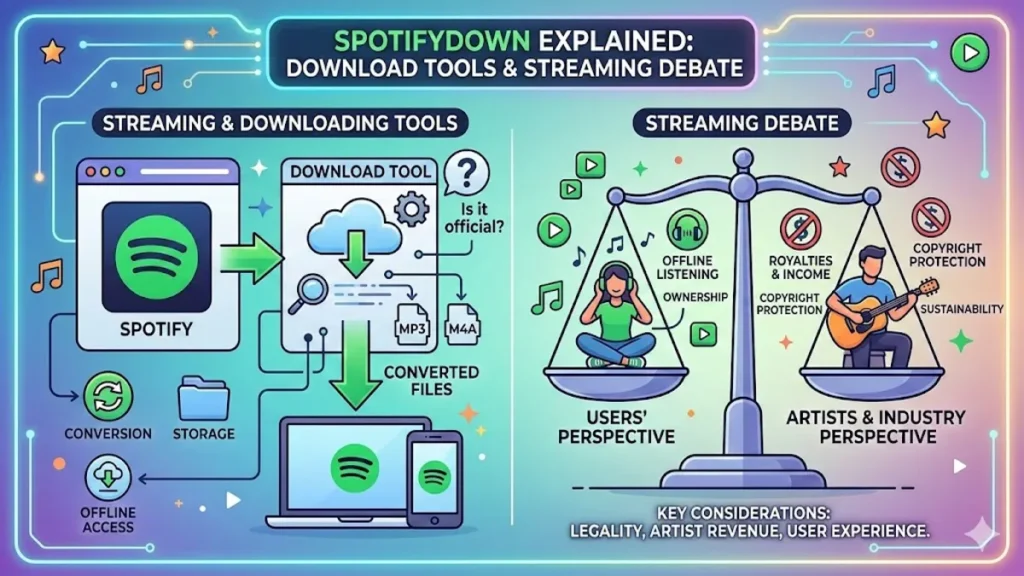

I often see people searching for the term “spotifydown” when they want to download songs from Spotify without using the platform’s built-in offline feature. The keyword typically refers to third-party websites or tools that claim to convert Spotify tracks into downloadable audio files. For users, the appeal is obvious: the ability to store songs permanently on a device without needing an internet connection or an active subscription.
Spotify itself, however, was designed as a streaming platform rather than a download service. While the company allows premium subscribers to download music for offline listening within its application, those files remain encrypted and cannot be used outside the Spotify ecosystem. Tools associated with the name “spotifydown” attempt to bypass that limitation by extracting or converting audio streams into formats such as MP3.
The existence of these tools raises complex questions about copyright law, digital rights management and the economics of music streaming. Streaming services have transformed how audiences access music, but they also rely on licensing agreements that compensate artists, record labels and publishers for every play.
Third-party download services challenge that model. Some users view them as convenient utilities, while industry organizations see them as threats to the sustainability of the streaming economy.
Understanding spotifydown requires examining the intersection of technology, consumer behavior and intellectual property law. The debate surrounding these tools reveals how digital platforms continue to reshape the way music is distributed, consumed and protected.
The Evolution of Music Consumption
The emergence of tools like spotifydown can only be understood within the broader history of digital music.
I often think back to the late 1990s when the MP3 format began transforming how people stored and shared songs. File-sharing networks such as Napster introduced millions of listeners to the idea that music could exist as freely transferable digital files.
This shift triggered a wave of legal battles between technology companies and the music industry. Record labels argued that unauthorized file sharing undermined artists’ livelihoods, while technology advocates saw digital distribution as an inevitable evolution.
Streaming platforms eventually emerged as a compromise. Instead of downloading files permanently, listeners could access massive libraries of music through online services.
Spotify, launched in 2008 in Sweden, became one of the most influential streaming platforms. The company’s model relied on licensing agreements with record labels and royalty payments based on the number of streams each song receives.
Music historian David Hesmondhalgh has argued that streaming platforms fundamentally changed the economics of music by prioritizing access over ownership.
The popularity of spotifydown reflects a lingering desire among some listeners to return to downloadable music files.
Read: Fry99.com Explained: What Fry99.com Is and Why People Are Searching for It Online
How Spotify’s Streaming System Works
Spotify’s technology is built around streaming rather than traditional file downloads. When users play a song, the platform delivers small segments of encrypted audio data through its servers.
I often explain this system as similar to watching a movie on a streaming service. The content is temporarily buffered on the device but remains protected by digital rights management systems.
Spotify allows premium users to download songs for offline listening, but those files remain encrypted and accessible only through the official app. If a subscription expires, the downloaded tracks can no longer be played.
Spotify Listening Modes
| Mode | Description |
|---|---|
| Online streaming | Music plays through internet connection |
| Offline listening | Premium users download encrypted tracks |
| Playlist syncing | Music stored temporarily in the app |
| Streaming radio | Algorithm-driven song recommendations |
This architecture ensures that every playback remains connected to Spotify’s licensing and royalty systems.
What Spotifydown Tools Claim to Do
Websites associated with the term spotifydown typically promise a simple function: converting Spotify music into downloadable files.
I have observed that these tools usually operate by accepting a Spotify track link. The site then attempts to locate an equivalent audio source, often from public video platforms or alternative music databases.
Once the matching audio is identified, the tool converts it into formats such as MP3 and allows the user to download it.
Typical Features of Download Tools
| Feature | Purpose |
|---|---|
| Link conversion | Transform Spotify URLs into downloadable files |
| Audio format selection | MP3 or other audio formats |
| Metadata extraction | Song title and artist information |
| Batch downloading | Multiple songs at once |
While these services appear straightforward, they operate in a complex legal and technical environment.
Legal Questions Surrounding Download Tools
The legality of tools like spotifydown remains heavily debated. Streaming platforms negotiate licensing agreements that specify how music can be distributed and accessed.
When third-party services convert streaming content into permanent files, they may violate those licensing terms.
The International Federation of the Phonographic Industry has repeatedly warned that unauthorized download tools undermine the economic model that supports artists and record labels.
Copyright law in many countries protects recorded music as intellectual property. Distributing or reproducing copyrighted works without permission can lead to legal consequences.
Law professor Lawrence Lessig has written extensively about the tension between technological innovation and copyright protection in the digital age.
According to Lessig, digital technologies often challenge existing legal frameworks, forcing societies to reconsider how intellectual property should be regulated.
The Economics of Streaming and Artist Compensation
One reason the music industry strongly opposes unauthorized download tools is their potential impact on artist revenue.
Streaming services pay royalties based on the number of times a song is played. Each stream generates a small payment that contributes to an artist’s total earnings.
Revenue Sources in Streaming
| Source | Description |
|---|---|
| Streaming royalties | Payments per play |
| Advertising revenue | Free-tier listening |
| Subscription fees | Premium accounts |
| Licensing deals | Distribution agreements |
Music industry analysts note that streaming has become the primary source of recorded music revenue worldwide.
According to the International Federation of the Phonographic Industry, streaming accounted for more than 65 percent of global recorded music revenue by the early 2020s.
When listeners download songs through unauthorized tools, those plays may bypass the royalty system entirely.
Security and Privacy Risks
I often notice that users searching for spotifydown tools are primarily focused on convenience. However, cybersecurity researchers warn that such websites can carry risks.
Because many of these services rely on advertising networks with limited oversight, users may encounter pop-up advertisements, tracking scripts or deceptive download buttons.
Cybersecurity expert Brian Krebs has warned that websites offering free downloads frequently become targets for malicious advertising campaigns.
Another concern involves data privacy. Some download tools require users to paste links or interact with scripts that may collect browsing information.
For these reasons, many digital safety experts recommend caution when interacting with unfamiliar download websites.
Cultural Tensions in the Streaming Era
The popularity of spotifydown tools reflects deeper cultural tensions in the digital music era.
Streaming services emphasize access rather than ownership. Listeners can explore millions of songs instantly but rarely possess permanent copies of the music they enjoy.
I often hear users express frustration with this model. Some prefer the sense of control that comes with owning music files stored on their personal devices.
Media scholar Mark Mulligan has described this shift as the transition from “music ownership to music access.” While streaming offers convenience, it also reshapes how audiences think about collecting music.
The persistence of download tools suggests that some listeners still value the autonomy associated with digital files.
Expert Perspectives on Digital Music Distribution
Music industry experts continue to debate how streaming platforms and download tools influence the future of music.
Lawrence Lessig has emphasized the need for balanced copyright policies that protect creators while allowing technological innovation.
David Hesmondhalgh argues that streaming services have transformed the cultural economy of music by shifting revenue structures toward platforms rather than physical media.
Meanwhile, cybersecurity researcher Brian Krebs highlights the security risks associated with unauthorized download sites.
Together, these perspectives illustrate the complex intersection of technology, economics and law in modern music distribution.
Key Takeaways
• Spotifydown refers to tools that claim to convert Spotify tracks into downloadable audio files
• Spotify’s official platform uses encrypted streaming rather than permanent downloads
• Unauthorized download tools raise legal concerns related to copyright and licensing
• Streaming has become the primary revenue source for the global music industry
• Some download sites may expose users to cybersecurity risks
• The debate reflects broader tensions between digital access and music ownership
Conclusion
I often think about how dramatically the music industry has changed since the early days of digital downloads. Streaming services like Spotify have transformed listening habits by offering instant access to vast music libraries.
Yet the search for tools like spotifydown reveals that the transition from ownership to access remains incomplete. Some listeners still prefer downloadable music files that can be stored and used without restrictions.
This tension highlights the broader challenges facing digital media platforms. Companies must balance user convenience with the licensing agreements that support artists and the broader music ecosystem.
As technology continues to evolve, the conversation around digital music distribution will likely continue. Whether through improved streaming features, new licensing models or alternative platforms, the industry will keep searching for ways to satisfy both creators and audiences.
Spotifydown may represent a small part of that larger debate, but it illustrates how technology, culture and law intersect in the modern digital world.
FAQs
What is spotifydown
Spotifydown typically refers to websites or tools that claim to convert Spotify music into downloadable audio files such as MP3.
Is downloading music from Spotify through third-party tools legal
Downloading copyrighted music without authorization may violate copyright laws and the terms of service of streaming platforms.
Can Spotify songs be downloaded officially
Yes. Spotify allows premium subscribers to download songs for offline listening within the official app.
Are spotifydown websites safe
Some may contain advertisements, tracking scripts or malicious links. Users should exercise caution when visiting unfamiliar download sites.
Why do people use music download tools
Some listeners prefer owning music files that can be stored permanently and played without relying on streaming services.