
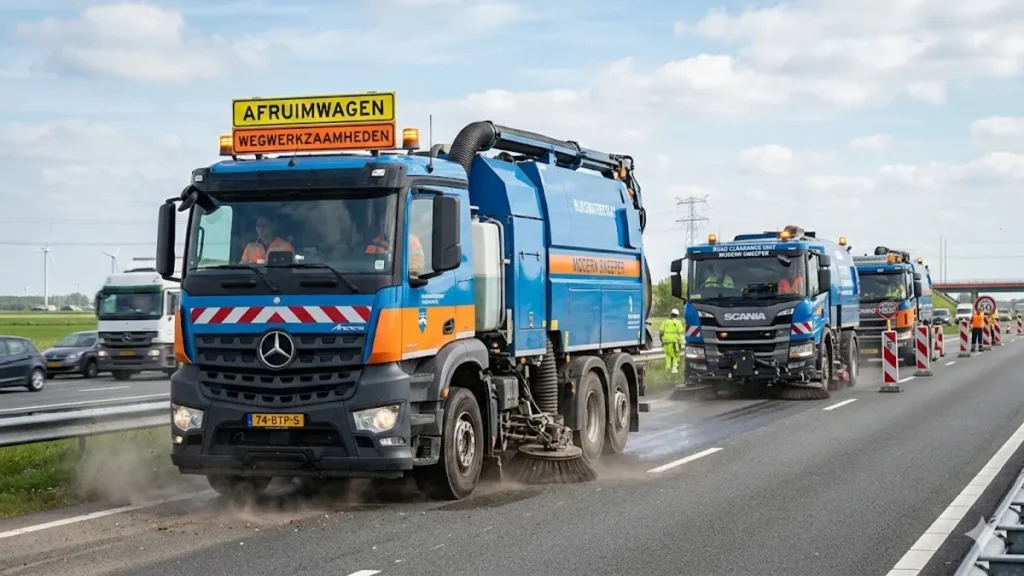

I have always been fascinated by the machinery that quietly keeps cities functioning during extreme weather. Afruimwagens, a term widely used in Dutch-speaking regions, refer to specialized vehicles designed to clear roads, remove obstacles, and restore safe passage after storms, accidents, or debris accumulation. These machines are most commonly associated with winter road maintenance, where they push snow aside, distribute salt, and reopen highways after heavy snowfall.
In the first moments after a blizzard or a fallen tree blocks a highway, afruimwagens are often the first vehicles dispatched. Municipal agencies, highway authorities, and emergency services rely on these machines to maintain transportation networks when conditions deteriorate. Their work determines whether commuters can reach workplaces, emergency responders can access neighborhoods, and supply chains remain uninterrupted.
The vehicles themselves vary widely in design. Some are massive snowplow trucks equipped with rotating blades and salt spreaders. Others resemble heavy-duty loaders capable of removing debris, wreckage, or construction waste. In dense urban areas, compact variants navigate narrow streets and sidewalks.
Across Europe, particularly in countries such as the Netherlands, Germany, and Switzerland, afruimwagens form the backbone of winter maintenance fleets. The efficiency of these vehicles has become increasingly important as climate volatility produces both heavier snowfalls and sudden freeze events.
Though they rarely receive public attention, afruimwagens represent an essential intersection of engineering, logistics, and public safety. Their presence on winter roads symbolizes a quiet promise: that even in the harshest conditions, infrastructure will continue to function.
The Meaning and Origins of the Term “Afruimwagens”
The word “afruimwagens” originates from Dutch. It combines two components: “afruimen,” meaning to clear away or remove, and “wagens,” meaning vehicles or wagons. Together, the term describes vehicles specifically designed for clearing operations.
Historically, such vehicles emerged alongside the mechanization of road maintenance during the early twentieth century. Before motorized equipment became widespread, snow removal and debris clearing were largely manual tasks performed with shovels, horses, and rudimentary plows.
The rise of motorized snowplows in the 1920s and 1930s transformed winter road management. Engineers began attaching plow blades to trucks, allowing operators to clear large sections of roadway in a fraction of the time required by manual labor.
By the mid-twentieth century, European municipalities began developing specialized fleets dedicated to winter service. Afruimwagens evolved into multi-purpose machines capable of plowing snow, spreading salt, clearing fallen branches, and removing wreckage after accidents.
Transportation historian John B. Rae noted in his work on highway development:
“Snow removal technology dramatically expanded the year-round usability of road networks.”
The modern afruimwagen is the result of decades of incremental improvements in vehicle engineering, hydraulics, and road maintenance strategy.
Read: Sosoactive: Where Millennials and Gen Z Forge Vibrant Digital Communities
The Role of Afruimwagens in Winter Infrastructure
In countries with cold climates, winter maintenance represents a massive logistical undertaking. Governments must ensure that highways, city streets, and rural roads remain safe and navigable even during heavy snowfall.
Afruimwagens are central to that effort.
Municipal fleets deploy these vehicles in coordinated routes designed to clear primary transportation corridors first. Highways and major arteries receive priority because they carry emergency vehicles and commercial traffic. Residential streets are typically cleared afterward.
A standard winter service vehicle often includes several integrated components:
- A front-mounted plow blade
- Side plows for wider coverage
- Salt or brine spreaders
- GPS-based route tracking systems
These features allow afruimwagens to clear snow while simultaneously preventing ice formation. According to the U.S. Federal Highway Administration, timely snow removal significantly reduces accident rates during winter storms.
Infrastructure engineer Mark DeSantis explains:
“Efficient snow removal is one of the most effective ways to maintain road safety during extreme weather.”
The reliability of afruimwagens therefore has direct implications for public safety.
Types of Afruimwagens Used in Road Maintenance
Not all afruimwagens perform the same tasks. Municipal maintenance fleets typically include multiple vehicle types designed for different clearing operations.
Common Types of Afruimwagens
| Type | Primary Function | Typical Environment |
|---|---|---|
| Snowplow trucks | Push snow from road surfaces | Highways and city streets |
| Salt spreader vehicles | Distribute salt or brine to prevent ice | Major roads |
| Loader-based clearance vehicles | Remove heavy debris or snow piles | Urban centers |
| Compact sidewalk plows | Clear pedestrian pathways | Residential districts |
Snowplow trucks are the most recognizable. These vehicles attach large steel blades to the front of heavy-duty trucks, pushing snow toward road shoulders.
In dense urban environments, compact vehicles perform similar functions on sidewalks and narrow streets where larger trucks cannot operate effectively.
The variety of vehicle types reflects the complexity of modern road maintenance systems.
Technological Advances in Snow Clearing Vehicles
Modern afruimwagens incorporate sophisticated technologies that improve efficiency and environmental performance.
GPS tracking systems allow operators to follow optimized clearing routes. These systems also enable fleet managers to monitor which roads have been serviced and which require additional attention.
Sensors mounted on spreader equipment measure road temperature and adjust salt application rates accordingly. This prevents unnecessary salt usage while ensuring effective ice control.
According to the European Road Maintenance Association, excessive salt application can harm vegetation and water systems. Smart spreading systems reduce environmental impact by precisely controlling dosage levels.
Mechanical engineer Anna Hofmann, who studies winter service equipment, notes:
“The goal today is precision maintenance. Technology helps operators apply exactly the right treatment at the right moment.”
Another innovation is the use of liquid brine instead of dry salt. Brine adheres better to road surfaces and begins melting ice immediately upon contact.
These advancements reflect a broader trend toward data-driven infrastructure management.
Municipal Logistics and Fleet Coordination
Operating a fleet of afruimwagens requires careful logistical planning. Municipal agencies typically maintain detailed winter service plans outlining routes, priorities, and response strategies.
During severe weather events, operations centers coordinate dozens or even hundreds of vehicles simultaneously. Drivers communicate through digital dispatch systems that provide real-time updates on road conditions.
Example Winter Maintenance Priority System
| Priority Level | Road Type | Typical Response Time |
|---|---|---|
| Level 1 | Highways and emergency routes | Immediate |
| Level 2 | Major urban roads | Within several hours |
| Level 3 | Residential streets | After main roads cleared |
This tiered approach ensures that essential transportation routes remain functional even during heavy snowfall.
Urban planners emphasize that such systems must balance efficiency with public expectations. Residents often expect their local streets to be cleared quickly, even though infrastructure priorities dictate otherwise.
Effective communication therefore plays a crucial role in winter maintenance operations.
Afruimwagens Beyond Snow Removal
Although snow clearing remains their most visible role, afruimwagens also perform other critical tasks.
In many municipalities, these vehicles assist with:
- Clearing fallen trees after storms
- Removing accident debris from highways
- Transporting large waste materials
- Supporting construction site cleanup
In disaster response scenarios, heavy clearance vehicles can help reopen blocked roads after floods, landslides, or earthquakes.
Emergency management expert David Alexander has emphasized the importance of rapid debris removal in disaster recovery:
“Restoring transportation routes is one of the first steps in effective emergency response.”
Afruimwagens therefore contribute not only to winter safety but also to broader infrastructure resilience.
Environmental Challenges and Sustainability
The environmental impact of winter road maintenance has become an increasingly important issue. Traditional rock salt, while effective at melting ice, can damage roadside vegetation, contaminate groundwater, and corrode vehicles.
Transportation agencies across Europe and North America are exploring alternatives such as:
- Calcium magnesium acetate
- Liquid brine mixtures
- Organic additives derived from agricultural byproducts
Some municipalities are also experimenting with electric or hybrid winter service vehicles to reduce emissions.
According to research from the Transportation Research Board, improved spreading technologies can reduce salt usage by up to 30 percent without compromising road safety.
Sustainability considerations are therefore shaping the next generation of afruimwagens.
Takeaways
- Afruimwagens are specialized vehicles used to clear snow, debris, and road obstructions.
- The term originates from Dutch and refers broadly to clearance vehicles used in municipal maintenance.
- These vehicles play a crucial role in maintaining road safety during winter storms.
- Modern afruimwagens incorporate technologies such as GPS routing and smart salt spreaders.
- Municipal fleets use tiered priority systems to determine which roads are cleared first.
- Clearance vehicles also support disaster response and infrastructure recovery.
- Environmental concerns are driving innovations in sustainable winter maintenance.
Conclusion
Afruimwagens rarely appear in news headlines, yet their impact is felt whenever winter weather threatens to paralyze transportation networks. These vehicles represent the quiet backbone of municipal infrastructure, enabling cities and highways to remain functional even under severe conditions.
Behind every cleared roadway lies a coordinated system of planning, engineering, and logistics. Operators drive long shifts through snowstorms. Dispatchers monitor weather patterns and vehicle locations. Engineers continue refining equipment to make snow clearing more efficient and environmentally responsible.
The future of afruimwagens will likely involve even greater technological integration. Autonomous route optimization, sensor-driven road monitoring, and alternative deicing materials may transform how winter maintenance is performed.
But the core mission will remain unchanged: keeping roads open and communities connected when nature tests the limits of infrastructure.
In that sense, the rumble of an afruimwagen pushing through fresh snow is more than a mechanical sound. It is a signal that the systems supporting modern life are still at work.
FAQs
What does the word “afruimwagens” mean?
Afruimwagens is a Dutch term meaning clearance vehicles. It refers to trucks or machines designed to remove snow, debris, or other obstacles from roads and public spaces.
Where are afruimwagens commonly used?
They are widely used in European countries such as the Netherlands, Germany, Switzerland, and Belgium, particularly for winter road maintenance.
Are afruimwagens only used for snow removal?
No. While snow clearing is their most common role, these vehicles also remove debris, fallen trees, and accident wreckage from roads.
What technology do modern snow-clearing vehicles use?
Modern vehicles often include GPS tracking, automated salt spreaders, road temperature sensors, and hydraulic plow systems.
Why is road salt controversial?
Road salt can damage vegetation, corrode infrastructure, and contaminate waterways, which has led to research into more sustainable alternatives.


