
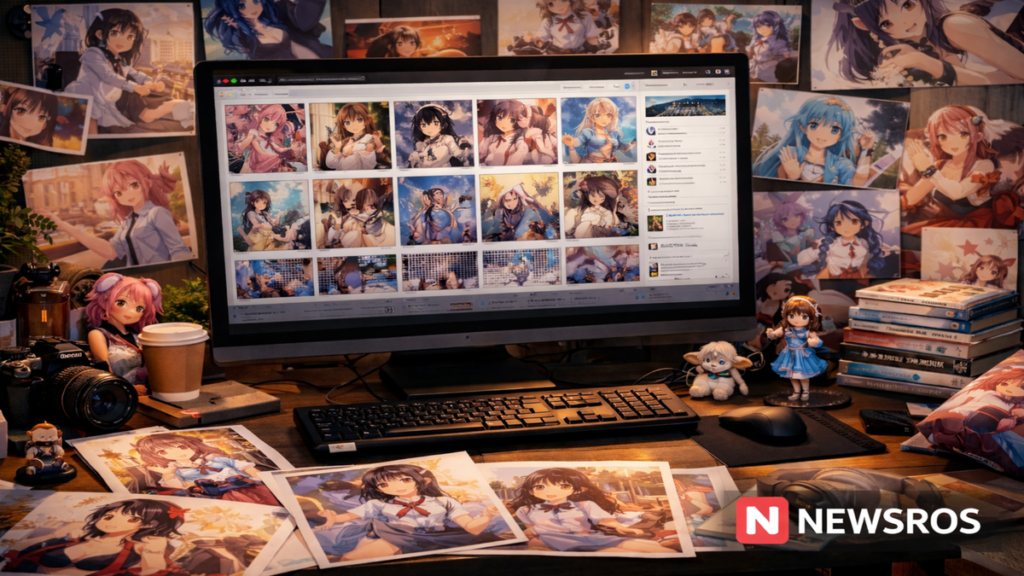

I often think of the internet not as a single place but as a constellation of smaller worlds. Some are enormous and familiar, like YouTube or Reddit. Others exist quietly in the background, populated by tight-knit communities whose cultures are invisible to most of the web. Allthefallen is one of those worlds. At its simplest, it is a niche online platform where users share anime-inspired artwork and participate in discussion forums built around fandom culture. The site operates using a “booru” system, a database-style imageboard where uploaded images are categorized with detailed tags that make vast libraries of artwork searchable and navigable (EverybodyWiki, 2025).
In practice, Allthefallen functions as both a gallery and a community hub. Users upload illustrations, fan art, memes, and digital media inspired by anime and video games. Others browse, tag, comment on, and organize that content. Over time, the platform has developed a layered ecosystem including forums, chat channels, and translation projects that mirror the collaborative spirit of anime fandom.
Yet the site’s existence also reflects deeper questions about how internet communities organize themselves. Small independent platforms operate differently from corporate social networks. They are often moderated by volunteers, shaped by community norms, and driven by the enthusiasm of users rather than algorithms designed for advertising.
This dynamic can create vibrant creative spaces, but it can also bring controversy. Allthefallen has periodically drawn attention in online debates about moderation, ethics, and the boundaries of fan expression. To understand why the platform exists and why it provokes discussion, it helps to step back and look at the broader ecosystem of internet fandom that produced it.
The Origins of the Platform
When I trace the roots of Allthefallen, the story leads back to the early growth of anime communities online during the late 2000s and early 2010s. During that period, fan art sites and discussion boards multiplied across the internet. Fans who loved Japanese animation, manga, and games were searching for places where they could share artwork, remix stories, and interact with others who understood the same cultural references.
Allthefallen emerged in that environment as a community-driven project built around a booru imageboard system. The term “booru” originated from Danbooru, a Japanese-style imageboard launched in 2005 that introduced a powerful tagging structure for organizing images. Instead of relying on folders or simple categories, users could apply dozens of descriptive tags to a single image. These tags might include the character name, series title, art style, mood, or visual features present in the artwork.
The tagging system proved revolutionary for online art archives. A single search query could instantly filter through thousands of images.
Allthefallen adopted this model and expanded it into a broader network of services. The platform eventually included image repositories, community forums, and collaborative translation projects. While the precise timeline of the platform’s development is difficult to reconstruct due to limited documentation, internet archives and community discussions suggest that it gradually grew through word of mouth among anime fans.
Like many niche communities, its growth was organic rather than strategic.
The Booru System Explained
To understand how Allthefallen works, it is essential to understand the mechanics of the booru architecture that powers it. Booru systems operate as collaborative databases rather than traditional social networks.
When users upload an image, they attach multiple tags describing the content. These tags become part of a massive searchable index. Over time, the community collectively builds a structured catalog of images that can be browsed in highly specific ways.
For example, a single anime illustration might be tagged with:
- The name of the character
- The anime series the character belongs to
- Visual attributes such as hair color or clothing
- Artistic style or medium
The result is a flexible indexing system capable of organizing enormous collections of artwork.
| Core Feature | Description | Impact on Users |
|---|---|---|
| Image uploads | Community members contribute artwork | Expands the archive |
| Tagging system | Users label images with metadata | Enables precise searches |
| Community voting | Popular images rise in visibility | Encourages engagement |
| Comment threads | Users discuss artwork | Creates social interaction |
Booru systems transformed how anime art communities operate online. Rather than browsing randomly, users can explore highly curated collections built collaboratively by thousands of participants.
A Community Rooted in Fandom
Allthefallen is deeply connected to the culture of anime fandom. For decades, anime fans have been among the most active creators of fan art and fan fiction on the internet. The communities that form around these works are often highly collaborative.
Artists upload sketches and finished illustrations. Writers share story adaptations or alternative narratives involving popular characters. Other users respond with comments, critiques, and suggestions.
This collaborative process is a hallmark of what media scholar Henry Jenkins describes as participatory culture.
“Fans are not simply consumers of media texts,” Jenkins writes. “They are active participants who reshape and reinterpret them” (Jenkins, 2006).
Platforms like Allthefallen embody this principle. They allow fans to reinterpret fictional worlds in their own ways. Characters from popular anime series appear in countless artistic variations, each reflecting the imagination of a different creator.
The process resembles a living archive of fandom creativity.
Infrastructure Behind the Community
Although Allthefallen appears simple on the surface, the platform relies on a technical structure that supports multiple services simultaneously. The main domain typically hosts several subdomains dedicated to different functions within the community.
| Service Area | Purpose |
|---|---|
| Imageboard | Database of tagged images |
| Forums | Long-form discussions |
| Chat channels | Real-time conversation |
| Translation sections | Collaborative fan translations |
This architecture reflects a common pattern among independent online communities. Rather than relying on a single application, the platform integrates several tools that allow users to interact in different ways.
Behind the scenes, servers host the image databases and handle the tagging system that organizes the artwork. These systems are often built using open-source software originally developed for booru-style websites.
The community itself plays a major role in maintaining the database. Users correct tags, remove duplicates, and add new categories as the archive grows.
In effect, the platform becomes a collaborative information system curated by the community itself.
Growth Through Online Subculture
For many years, Allthefallen remained largely unknown outside niche fandom circles. Its growth came primarily through word of mouth. Users who discovered the platform through forums or links from other anime communities invited friends or fellow fans.
This pattern is common in online subcultures. Instead of marketing campaigns, communities grow through social networks of shared interests.
But the internet changed dramatically during the 2010s. Social media platforms began amplifying discussions from smaller communities. Blog posts and Reddit threads occasionally brought attention to obscure websites.
When that happens, niche platforms often face a sudden shift. Their internal culture, shaped by a small group of participants, becomes visible to outsiders with different expectations.
Allthefallen experienced this dynamic as conversations about the site appeared across various internet forums. These discussions often focused on the platform’s moderation practices and the boundaries of fan-generated content.
Content Moderation and Governance
Moderation is one of the most complex challenges for any online community. Large corporate platforms rely on professional teams, automated systems, and legal frameworks to manage content.
Smaller community-run platforms operate very differently.
Allthefallen appears to rely largely on volunteer administrators and community guidelines. This decentralized moderation structure is common among independent internet communities.
Internet governance researcher Tarleton Gillespie argues that moderation is fundamentally a social process.
“Content moderation is not simply a technical task,” Gillespie writes. “It reflects cultural judgments about what communities consider acceptable” (Gillespie, 2018).
In communities like Allthefallen, these judgments are often shaped by the users themselves. Members debate what should remain on the platform and what should be removed.
Such debates illustrate how online communities negotiate their own standards.
Comparing Allthefallen With Similar Platforms
Allthefallen exists within a broader ecosystem of anime art platforms. Several well-known websites use similar structures while serving different audiences.
| Platform | Primary Focus | Moderation Approach | Community Size |
|---|---|---|---|
| Danbooru | Large anime art archive | Structured moderation | Global |
| Gelbooru | Open tagging community | Looser moderation | Large |
| Pixiv | Japanese artist network | Corporate policies | Massive |
| Allthefallen | Niche fandom community | Community-driven | Smaller |
Each platform reflects a different philosophy about online creativity.
Corporate networks like Pixiv often maintain strict guidelines due to legal and commercial considerations. Community-driven platforms tend to prioritize creative freedom and collaborative tagging systems.
These differences shape how users experience each site.
The Role of Anonymity
Anonymity is another defining feature of many internet communities, including Allthefallen. Many users participate under pseudonyms or anonymous identities.
For artists, anonymity can be liberating. It allows them to experiment with styles and ideas without worrying about professional consequences or public judgment.
Digital culture researcher Whitney Phillips notes that anonymity has long been central to internet participation.
“Anonymous environments can encourage experimentation with identity and expression,” Phillips writes.
However, anonymity also introduces challenges. Without clear identities, enforcing rules and maintaining accountability becomes more difficult.
Online communities constantly balance these competing forces.
Expert Perspectives on Digital Fan Communities
Scholars studying internet culture often emphasize that communities like Allthefallen are not unusual. They are natural outcomes of decentralized online communication.
Digital anthropologist Mizuko Ito has studied how online fan communities foster creativity and collaboration.
“Participatory cultures encourage learning through sharing and collective experimentation,” Ito explains (Ito et al., 2010).
Within these spaces, amateur artists frequently develop professional-level skills. Feedback from peers can help creators refine their techniques and discover new approaches.
In many cases, artists who begin in fan communities eventually transition into professional illustration or animation careers.
Thus, niche platforms can act as informal incubators for creative talent.
Key Takeaways
• Allthefallen is a niche anime-focused online community built around a booru-style imageboard system.
• The platform allows users to upload, tag, and organize artwork collaboratively.
• It represents a broader tradition of participatory fan culture on the internet.
• Community-driven moderation distinguishes it from corporate social media platforms.
• Debates about ethics and moderation frequently surround decentralized online communities.
• The platform illustrates how small internet communities can develop complex cultures of their own.
Conclusion
Looking at Allthefallen from a distance, it might appear to be just another obscure website among millions that populate the internet. But a closer look reveals something more revealing about digital culture itself.
Communities like this demonstrate how the internet continues to fragment into specialized spaces where people gather around shared interests. Within those spaces, users create their own systems of organization, governance, and creative exchange.
Allthefallen shows both the promise and complexity of this decentralized internet. It can nurture artistic collaboration and fandom creativity, allowing users to build vast archives of shared cultural expression. At the same time, it illustrates the challenges that arise when communities operate outside the regulatory frameworks of major platforms.
The story of Allthefallen ultimately reflects a broader truth about the internet: it is not a single culture but a mosaic of overlapping communities, each shaped by its own norms and values.
Read: BetMentor Top Betting Sites Explained
FAQs
What is Allthefallen?
Allthefallen is an online platform where users share anime-inspired artwork and participate in forums and community discussions built around fandom culture.
What does “booru” mean?
A booru is an imageboard system where users upload pictures and organize them using descriptive tags, creating searchable art archives.
Is Allthefallen similar to Danbooru?
Yes. Both platforms use tagging systems to organize anime artwork, though they differ in community size and moderation policies.
Who uses Allthefallen?
The site is mainly used by anime fans, digital artists, and members of niche online communities interested in fan-created content.
Why do people join platforms like Allthefallen?
Users often join to share artwork, discover new fan art, and interact with communities centered around anime and gaming culture.