
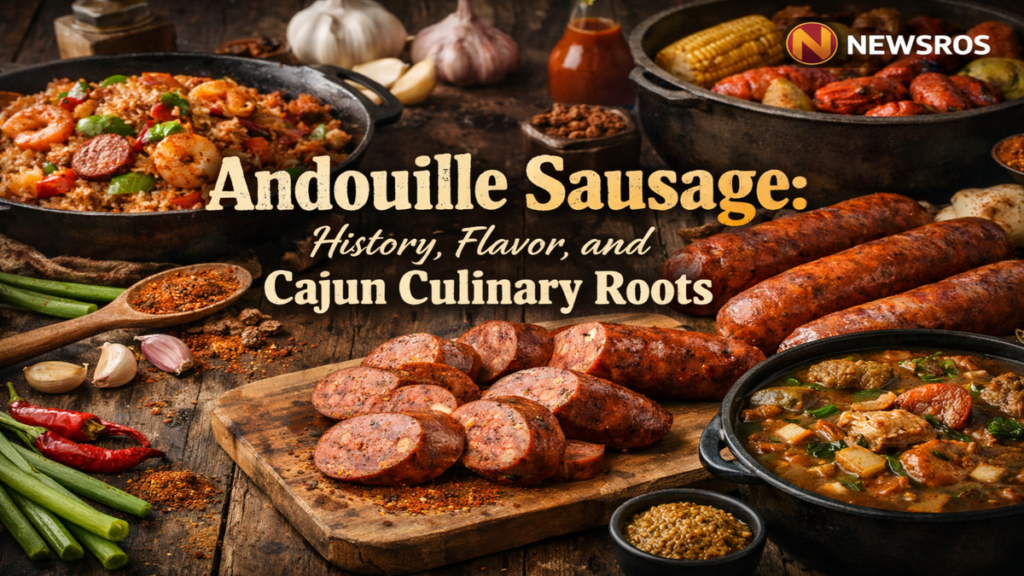

I have always believed that certain foods tell stories larger than their ingredients, and andouille sausage is one of them. At first glance it appears to be simply a smoked pork sausage, yet its aroma and flavor carry the weight of centuries of culinary migration. In kitchens across Louisiana, cooks slice it into gumbo or jambalaya not merely for protein but for the smoky backbone of flavor that defines Cajun cuisine. Within the first few minutes of simmering, the sausage releases spices, garlic, and smoke into a dish, transforming broth or rice into something unmistakably Southern.
Andouille sausage originated in France but achieved its most recognizable form in Louisiana. French settlers and Acadian refugees brought sausage-making traditions to North America in the eighteenth century. Over generations, those traditions changed in response to climate, available ingredients, and the influence of other cultures. The Louisiana version gradually replaced organ meats with pork shoulder, intensified the spice blend, and relied on hardwood smoke to preserve and flavor the meat. The result became a sausage with a coarse texture, rich aroma, and assertive seasoning that made it ideal for slow-cooked regional dishes.
Today andouille is recognized worldwide as a defining ingredient of Cajun and Creole cooking. Yet the sausage is more than a culinary tool. It represents adaptation, migration, and the blending of cultural traditions. From medieval French butcher shops to modern Louisiana smokehouses, its story reveals how food travels with people and evolves wherever it lands.
Medieval French Origins and the Birth of a Charcuterie Tradition
The earliest history of andouille sausage begins in France, where charcuterie developed as both a culinary craft and a survival strategy. Long before refrigeration existed, butchers preserved meat by salting, smoking, drying, or fermenting it. Sausages became a particularly efficient solution because they allowed cooks to combine various cuts of meat with spices and preserve them inside casings.
In traditional French cuisine, andouille emerged as a distinctive sausage made primarily from pork intestines and stomach lining. Unlike many sausages made from finely ground meat, this version used chopped pieces of offal that were seasoned and stuffed into natural casings. The mixture was often smoked or poached, producing a sausage with a strong aroma and earthy flavor. French culinary records from the eighteenth century describe regional varieties that differed in seasoning and preparation but maintained the same basic identity.
Different regions of France cultivated their own interpretations. In Brittany and Normandy, andouille became an important local specialty sold in charcuterie shops and markets. Some versions were lightly smoked while others relied more heavily on spices or wine for flavor. The sausage’s pungent character meant that it was rarely eaten alone. Instead, it was typically served alongside potatoes, bread, or mustard, allowing the strong flavor to complement simpler foods.
The French tradition emphasized using every part of the animal, and andouille reflected that philosophy. By transforming less desirable cuts into flavorful preserved meat, butchers turned necessity into culinary art. This principle of resourcefulness would later become a defining element of Cajun cooking as well.
Migration, Acadian Culture, and the Journey to Louisiana
The transformation of andouille sausage began with one of the most significant migrations in North American history. During the mid-eighteenth century, thousands of French-speaking Acadians were expelled from present-day Nova Scotia by British authorities. This event, known as the Great Expulsion, forced many families to seek new homes across the Atlantic world. Some eventually settled in southern Louisiana, where their descendants would become known as Cajuns.
These settlers carried their culinary traditions with them, including sausage-making techniques inherited from France. Yet Louisiana presented an entirely different environment. The region’s humid climate affected preservation methods, and local ingredients differed from those available in Europe. In addition, the Acadian settlers encountered a multicultural society shaped by Spanish colonial rule, African culinary traditions, Native American knowledge, and German immigration.
Within this context, andouille sausage gradually evolved. Instead of relying on pork intestines as the primary ingredient, Louisiana butchers began using pork shoulder and other cuts of meat that were more readily available. The seasoning also shifted, incorporating cayenne pepper and stronger garlic notes. Hardwood smoking became central to the process, both for preservation and for the deep flavor it imparted.
German immigrants in Louisiana’s River Parishes also influenced the transformation. Their expertise in sausage-making introduced techniques for coarse grinding and smoking that helped shape the Cajun version of the sausage. Over time, the Louisiana adaptation became so distinct that it effectively formed a new culinary tradition separate from the French original.
Cajun and Creole Kitchens Embrace the Sausage
As Cajun communities established themselves in Louisiana’s rural parishes, andouille sausage became an essential component of everyday cooking. The region’s cuisine relied heavily on slow-simmered dishes built around rice, beans, seafood, and vegetables. These foods required flavorful seasonings that could infuse large pots with depth, and smoked sausage proved ideal.
Gumbo, perhaps the most famous Louisiana stew, often begins with slices of andouille browned in a pot before other ingredients are added. The rendered fat enriches the base of the dish, while the smoky flavor permeates the broth. Similarly, jambalaya depends on sausage to season the rice and provide a savory counterpoint to vegetables and spices. Even simple dishes such as red beans and rice gain their distinctive taste from the sausage’s smoky richness.
In many rural communities, sausage-making remained a communal activity. Families gathered during seasonal hog butchering events called boucheries, transforming freshly slaughtered pigs into sausages, smoked meats, and preserved cuts. These gatherings were as much social celebrations as practical food preparation sessions. Recipes were shared, techniques passed down, and traditions reinforced through collective labor.
Within this environment, andouille became more than an ingredient. It represented continuity with the past and pride in regional identity. A well-made sausage signaled culinary skill and family heritage, and many Louisiana smokehouses still guard their recipes carefully.
The Structure and Flavor Profile of Andouille Sausage
The distinctive character of andouille sausage lies in its ingredients and preparation method. Unlike many commercial sausages that rely on finely ground meat, andouille typically contains chunks of pork that remain visible when sliced. This coarse texture provides a hearty bite and allows the flavors of smoke and spice to permeate the meat more effectively.
The sausage begins with pork shoulder, which offers an ideal balance of lean meat and fat. Butchers season the meat with garlic, onions, black pepper, cayenne, and sometimes paprika or thyme. The mixture is stuffed into natural casings before undergoing a prolonged smoking process. Hardwood such as pecan or hickory is commonly used because it produces a strong but balanced smoky flavor.
The smoking process is particularly important in Cajun andouille. Many producers smoke the sausage twice or allow it to smoke for extended periods, ensuring that the flavor penetrates deeply into the meat. This method not only enhances taste but also helps preserve the sausage, a technique rooted in centuries of culinary practice.
The resulting sausage possesses several defining characteristics. Its aroma is smoky and pungent, its texture firm and coarse, and its flavor both spicy and savory. These qualities make it particularly suited to dishes that cook slowly and require strong seasoning.
Differences Between French and Cajun Andouille
Although they share the same name, French and Cajun versions of andouille sausage differ significantly in ingredients, texture, and flavor. These differences highlight how culinary traditions evolve as they move across geographic and cultural boundaries.
The French version traditionally relies on pork intestines and stomach lining, producing a sausage with a distinctively earthy flavor. It is often lightly smoked or poached and served in charcuterie platters or simple dishes. Cajun andouille, by contrast, uses pork shoulder and relies heavily on smoking for both preservation and flavor. The Louisiana version is spicier and smokier, reflecting the bold seasoning typical of Cajun cuisine.
These variations illustrate how a recipe can transform while retaining its identity. The name and basic concept of andouille traveled from France to Louisiana, but the ingredients and techniques changed to suit a new culinary environment.
Louisiana’s Andouille Corridor and the Culture of Smokehouses
Certain regions of Louisiana have become particularly famous for producing andouille sausage. One of the most notable is the town of LaPlace, located along the Mississippi River between New Orleans and Baton Rouge. Often referred to as the “Andouille Capital of the World,” LaPlace hosts festivals and markets dedicated to the sausage.
The surrounding River Parishes form a corridor of smokehouses where traditional methods remain central to production. Many of these businesses are family-run operations that have passed down recipes for generations. The process often involves slow smoking over hardwood fires, allowing the sausage to develop its characteristic color and aroma.
Visitors traveling through this region encounter butcher shops displaying rows of smoked sausages hanging from wooden racks. The scent of pecan wood smoke drifts through the air, signaling the presence of an active smokehouse. For local residents, these establishments are more than businesses; they are cultural landmarks.
The persistence of these smokehouses demonstrates the enduring importance of traditional foodways. Even as industrial meat production dominates much of the global market, the River Parishes maintain a commitment to artisanal methods and regional identity.
The Role of Andouille in Signature Louisiana Dishes
Few ingredients shape a cuisine as profoundly as andouille influences Cajun cooking. Its smoky flavor acts as a seasoning agent that transforms otherwise simple ingredients into complex dishes.
In gumbo, the sausage is typically browned before being added to the stew. This step releases fat that enriches the roux and infuses the dish with smoky notes. In jambalaya, the sausage cooks alongside rice, vegetables, and spices, providing both flavor and texture. Red beans and rice rely on slices of andouille to give the slow-cooked beans their distinctive taste.
These dishes illustrate a fundamental principle of Cajun cooking: layering flavor through time. Rather than relying on a single seasoning, cooks build complexity gradually as ingredients simmer together. Andouille sausage plays a central role in this process because its smoke and spices disperse throughout the dish.
The sausage also functions as a bridge between ingredients. In seafood gumbos, for example, it connects the flavors of shrimp or crab with the earthy depth of roux and vegetables. Without andouille, many of these dishes would lose the richness that defines them.
Modern Variations and Nutritional Considerations
Although traditional andouille remains popular, modern dietary preferences have inspired new variations. Some producers now offer chicken or turkey versions that reduce fat content while preserving the characteristic smoky spice. Plant-based alternatives have also appeared in response to growing interest in vegetarian and vegan diets.
Despite these adaptations, classic pork andouille remains the benchmark against which all others are measured. Its robust flavor and firm texture continue to define the sausage in culinary contexts.
From a nutritional perspective, andouille is relatively high in sodium and fat, reflecting its origins as a preserved meat product. However, it is also rich in protein and can contribute significant flavor even in small quantities. Many cooks use it sparingly as a seasoning ingredient rather than the primary component of a dish.
The emergence of alternative versions demonstrates the flexibility of culinary traditions. While purists may prefer the original recipe, modern interpretations allow new audiences to experience the distinctive flavor profile of the sausage.
Takeaways
Andouille sausage began as a French charcuterie product made from pork intestines and preserved through smoking or poaching. When French-speaking settlers and Acadian refugees arrived in Louisiana during the eighteenth century, they brought sausage-making traditions with them. Over time, the recipe changed in response to local ingredients, climate, and cultural influences. Cajun andouille replaced organ meats with pork shoulder and emphasized heavy smoking and bold spices. The sausage became a foundational ingredient in Louisiana dishes such as gumbo, jambalaya, and red beans and rice. Regions like LaPlace and the River Parishes remain famous for traditional smokehouses that continue producing the sausage using artisanal techniques. Today andouille stands as a symbol of culinary adaptation and regional identity.
Conclusion
The story of andouille sausage stretches across continents and centuries, revealing how culinary traditions evolve as people move and adapt. What began in French charcuterie shops as a practical method of preserving pork eventually became a defining flavor of Louisiana cuisine. Along the way, cultural exchanges among French settlers, Acadian refugees, German immigrants, and other communities reshaped the sausage into something entirely new.
In modern kitchens, andouille remains both a historical artifact and a living ingredient. Smokehouses in Louisiana continue to follow time-honored methods, while chefs and home cooks incorporate the sausage into classic and contemporary recipes. Each slice carries traces of its journey from medieval Europe to the American South.
Food often serves as a record of human experience, and andouille illustrates that truth vividly. Its smoky aroma tells a story of migration, resilience, and creativity. Whether simmering in a pot of gumbo or sizzling in a skillet, the sausage continues to connect generations of cooks to the traditions that shaped it.
Click Here For More Blog Posts!
FAQs
What makes andouille sausage different from other sausages?
Andouille stands out because of its coarse texture and heavy smoking process. The pork pieces remain chunky rather than finely ground, and the sausage is strongly flavored with garlic, pepper, and cayenne.
Is andouille sausage always spicy?
Most Cajun versions contain noticeable heat from cayenne and black pepper. However, spice levels vary depending on the producer and recipe.
Can andouille sausage be eaten by itself?
Yes. Because it is smoked and usually pre-cooked, it can be grilled, pan-fried, or sliced and eaten on its own. It is most often used as an ingredient in larger dishes.
What dishes traditionally use andouille sausage?
Classic Cajun and Creole dishes such as gumbo, jambalaya, red beans and rice, and certain seafood stews commonly include andouille sausage.
Are there healthier alternatives to traditional andouille?
Some producers offer turkey, chicken, or plant-based versions that reduce fat or sodium while maintaining a similar smoky flavor profile.
References
Albala, K. (2011). Food cultures of the world encyclopedia. Greenwood.
Brekke, S. (2024). What is andouille sausage? Better Homes & Gardens. https://www.bhg.com/what-is-andouille-sausage-8777043
Edge, J. T. (2017). The Potlikker Papers: A food history of the modern South. Penguin Press.
Ogle, A. (2020). The Andouille Trail. Country Roads Magazine. https://countryroadsmagazine.com/cuisine/Louisiana-foodways/the-andouille-trail/
The Spruce Eats. (2021). What is andouille sausage? https://www.thespruceeats.com/what-is-andouille-995561
Wikipedia contributors. (2026). Andouille. Wikipedia. https://en.wikipedia.org/wiki/Andouille