

I began noticing the problem everywhere: the same company appearing under half a dozen spellings. A retailer written as “ACME Corp,” “Acme Corporation,” and “ACME.” A startup typed in all caps on one website and lowercase on another. Behind those seemingly harmless variations lies a surprisingly consequential issue in modern communication and data systems. Brand name normalization rules exist precisely to address this chaos, creating a consistent standard for how brand names are written, stored, and displayed across platforms.
In practical terms, brand name normalization refers to the process of converting variations of a brand’s name into a standardized representation. The goal is simple but powerful: one brand, one format. These rules apply widely in search engines, customer databases, content management systems, and marketing analytics platforms. When organizations follow normalization standards, they reduce duplication, improve data accuracy, and strengthen brand recognition across digital environments.
The stakes have grown dramatically in the digital age. Brands today live simultaneously across websites, social networks, databases, academic writing, advertising copy, and search engines. Each environment introduces opportunities for inconsistency. Misspellings, abbreviations, legal suffixes, and stylistic changes can fracture a brand’s identity across datasets.
Normalization rules solve that fragmentation. They provide structured guidelines for capitalization, punctuation, abbreviations, and trademark usage. In doing so, they ensure that organizations speak about themselves and are spoken about by others in a consistent way that machines and humans can both recognize.
What appears at first to be a minor editorial concern turns out to be a foundational element of modern information architecture.
Read: Serlig: Mastering the Art of Standing Out in a Busy World
The Origins of Brand Name Standardization
Long before the internet, editors and publishers confronted a simpler version of the same challenge. Newspapers, academic journals, and corporate communications departments needed consistent naming conventions to avoid confusion.
Style guides emerged as the solution. Publications adopted standardized rules governing capitalization, abbreviations, and proper nouns. The Associated Press Stylebook, first published in the early twentieth century, became one of the most influential frameworks for consistent language use in journalism.
These guides addressed questions that still matter today:
- Should a brand appear in all caps?
- When should legal suffixes like “Inc.” or “Ltd.” be used?
- Are trademark symbols necessary in written content?
Editorial standards gradually expanded from publishing into corporate branding and later into digital data systems. As organizations digitized customer records and product catalogs, inconsistencies became more than stylistic problems. They became operational issues.
A single company might appear in a database under multiple variations, fragmenting analytics, marketing insights, and customer histories. – brand name normalization rules.
Normalization rules emerged as the bridge between editorial consistency and technical data management.
Why Brand Name Normalization Matters in the Digital Economy
Modern organizations rely on enormous datasets: customer relationship management systems, product catalogs, supply chains, and advertising platforms. In these environments, inconsistent brand naming can create significant errors.
Company names often vary because of spelling differences, abbreviations, punctuation, or legal suffixes. Without normalization, databases may treat those variations as entirely separate entities.
This leads to several problems:
- Duplicate company records
- Misattributed sales data
- Inaccurate marketing analytics
- Fragmented customer histories
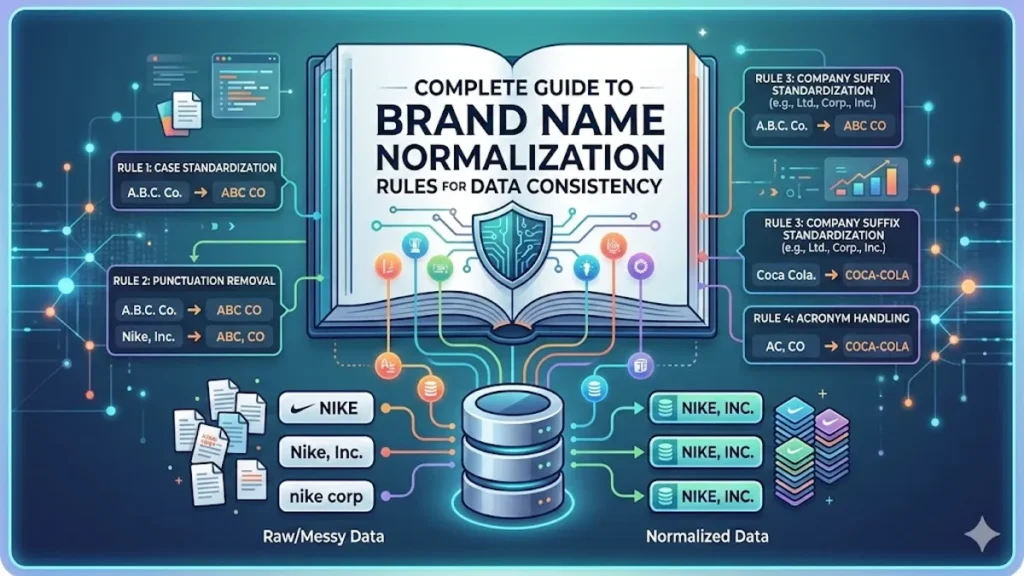
Normalization resolves these issues by transforming messy inputs into a consistent canonical form. In many systems, this involves removing legal suffixes, standardizing capitalization, and eliminating unnecessary punctuation.
Marketing strategist Alina Wheeler once summarized the principle succinctly:
“Consistency is the backbone of brand recognition. Every variation weakens that recognition.”
In the era of algorithmic search and automated analytics, that consistency is no longer optional. It is a requirement for accurate data interpretation.
Core Principles of Brand Name Normalization
Normalization rules vary across industries, but most systems rely on several fundamental principles.
1. Standardized Capitalization
Trade and brand names are typically treated as proper nouns, meaning they are capitalized in most writing contexts.
However, stylized brand forms present complications. Some companies intentionally use lowercase or unusual capitalization in their official branding.
Editorial guidelines generally recommend preserving the official styling whenever possible, unless the name begins a sentence.
2. Removing or Standardizing Legal Suffixes
Many normalization frameworks remove corporate suffixes such as:
- Inc.
- LLC
- Ltd.
- Corp.
These suffixes often provide little value in search or data analysis and can create duplicates if inconsistently applied.
3. Consistent Punctuation
Punctuation is frequently normalized by removing periods, commas, and extra characters unless they are part of the official brand name.
For example:
| Raw Input | Normalized Brand |
|---|---|
| ACME, Inc. | Acme |
| ACME Corporation | Acme |
| ACME CORP | Acme |
4. Abbreviation Management
Brands sometimes appear as abbreviations or full names.
Example:
| Variation | Normalized Form |
|---|---|
| IBM | IBM |
| International Business Machines | IBM |
Normalization systems typically map these variations to a single canonical representation.
Style Guides and Trademark Conventions
Normalization rules also intersect with writing style standards.
Academic and journalistic guidelines often recommend avoiding trademark symbols such as ™ or ® in standard prose. Both APA and Chicago style generally omit these symbols to maintain readability.
However, trademark ownership can still be acknowledged through context or legal notices when necessary.
Another important rule concerns formatting. Trademarked brand names are typically capitalized but not italicized in most writing contexts.
These conventions illustrate how normalization is not purely technical. It also reflects editorial traditions and legal considerations.
Brand Normalization in Data Systems
In large datasets, normalization often occurs through automated pipelines.
The process typically involves several steps:
- Data ingestion
- Pattern recognition
- Standardization rules
- Canonical mapping
Algorithms may remove punctuation, convert text to standardized capitalization, and compare names against a reference list.
A simplified workflow appears below.
| Step | Purpose |
|---|---|
| Data cleaning | Remove punctuation and inconsistent formatting |
| Tokenization | Break names into recognizable components |
| Mapping | Match variations to canonical brand forms |
| Deduplication | Merge duplicate records |
These systems increasingly rely on machine learning models that detect similarities between names.
“Normalization bridges the gap between human language variability and machine-readable consistency,” explains data scientist Rahul Mehta, who specializes in enterprise data architecture.
The SEO Dimension of Brand Name Consistency
Search engines depend heavily on entity recognition to interpret content. When a brand appears under multiple variations, search engines may struggle to associate those references with the same entity.
Normalization helps solve that problem.
Consistent brand naming improves:
- Knowledge graph accuracy
- Brand entity recognition
- Search ranking consistency
- Structured data reliability
For example, if an article refers to a company using several variations, search engines may interpret them as different organizations.
By contrast, consistent naming reinforces the entity relationship between pages, improving visibility and trust signals.
Digital marketing consultant Aleyda Solis notes:
“Search engines build entity understanding through repeated, consistent references.”
Normalization rules therefore support both technical SEO and brand credibility.
Normalization Across Global Markets
Global brands face additional complexity because names appear in multiple languages and alphabets.
Localization teams must balance translation with brand identity. Some brands keep their original names unchanged worldwide, while others adapt to local linguistic conventions.
Examples illustrate the challenge:
| Brand | Localized Variation |
|---|---|
| Coca-Cola | Ke Kou Ke Le (China phonetic translation) |
| Nike | Retained globally |
| McDonald’s | Local pronunciation variations |
Even when pronunciation changes, normalization rules often maintain a single canonical brand identifier in global databases.
This ensures accurate reporting across markets.
Common Pitfalls in Brand Name Normalization
Despite clear guidelines, organizations frequently encounter problems implementing normalization rules.
Over-Normalization
Excessive simplification can erase meaningful distinctions between brands with similar names.
Ignoring Official Brand Styling
Some companies rely heavily on unique capitalization or punctuation for identity. Removing those elements can weaken branding.
Inconsistent Application
Normalization must be applied systematically across all platforms, including:
- CRM systems
- Marketing tools
- Internal documents
- Public websites
Partial implementation creates confusion rather than solving it.
Marketing governance expert Denise Lee emphasizes:
“A normalization rule is only effective if every team uses it.”
Brand Normalization in the Age of Artificial Intelligence
Artificial intelligence is reshaping normalization processes.
Traditional rule-based systems required manual configuration. AI models now analyze patterns across massive datasets to identify brand variations automatically.
These systems can detect subtle similarities such as:
- Typographical errors
- Linguistic variations
- Abbreviation patterns
Machine learning approaches allow organizations to scale normalization across millions of records while maintaining accuracy.
Yet human oversight remains essential. AI can identify patterns, but editorial and legal decisions about brand representation still require human judgment.
Practical Guidelines for Implementing Normalization
Organizations typically adopt internal brand governance policies to enforce normalization.
Common steps include:
- Establish a canonical brand name list.
- Document capitalization and punctuation standards.
- Create mapping rules for abbreviations and suffixes.
- Integrate normalization into data pipelines.
- Train editorial and marketing teams.
The process often involves collaboration between marketing, legal, and data engineering teams.
Consistency across departments is essential.
Takeaways
- Brand name normalization standardizes how companies are referenced across systems and publications.
- Consistent naming improves data accuracy, search recognition, and brand identity.
- Normalization typically involves standardizing capitalization, punctuation, abbreviations, and legal suffixes.
- Style guides such as APA and Chicago influence editorial conventions for brand names.
- Search engines rely on consistent naming to recognize brand entities.
- AI tools increasingly automate normalization across large datasets.
- Effective normalization requires organization-wide governance.
Conclusion
Brand name normalization rules may appear invisible to most readers, but they shape how brands exist in the digital world. Beneath every search result, analytics dashboard, and product catalog lies a network of decisions about how a name should appear.
Consistency in naming does more than tidy up data. It strengthens identity. It ensures that a brand mentioned in a news article, a research paper, or a database record is recognized as the same entity across systems.
In an era defined by information overload, clarity becomes a competitive advantage. A company that maintains consistent naming practices signals professionalism, reliability, and attention to detail.
Normalization rules therefore serve a dual purpose. They help machines interpret data accurately while helping humans recognize and trust a brand.
And in the modern digital ecosystem, where perception and data are inseparable, that quiet discipline may be one of the most powerful branding tools available.
FAQs
What are brand name normalization rules?
Brand name normalization rules standardize how brand names are written across platforms, databases, and publications. They ensure consistency in capitalization, punctuation, abbreviations, and suffixes to prevent duplicate or confusing references.
Why is brand name normalization important for SEO?
Consistent brand naming helps search engines recognize entities correctly. When a brand appears consistently across content, search engines can associate references more accurately, improving visibility and search relevance.
Should trademark symbols be used in writing?
Many style guides recommend omitting trademark symbols such as ™ or ® in standard prose unless legally required. The brand name itself should simply be capitalized and written normally.
Do normalization rules remove “Inc.” or “Ltd.”?
Often yes. Many data systems remove legal suffixes like Inc., LLC, or Ltd. to reduce duplicate records, though legal contexts may still require them.
Is normalization used only in marketing?
No. It is widely used in databases, customer relationship systems, academic writing, search engines, and digital analytics platforms.


