
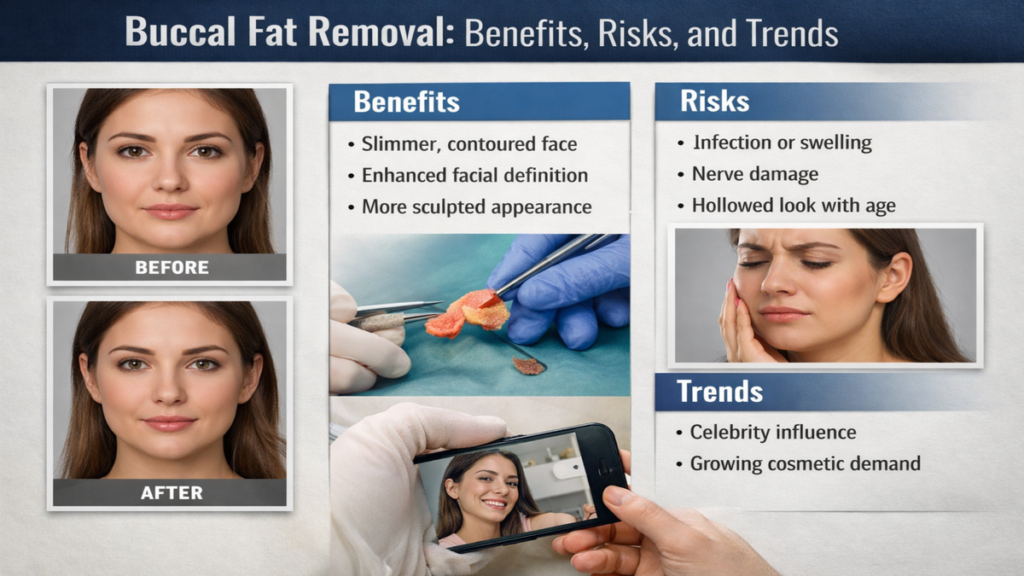

I begin with the question most people are quietly asking: what exactly is buccal fat removal, and why is it suddenly everywhere? In the simplest terms, it is a cosmetic surgical procedure that removes a small pocket of fat from the lower cheeks to create a more sculpted, angular facial appearance. Within the first few minutes of understanding it, the appeal becomes obvious. The procedure promises sharper cheekbones, a slimmer face, and a look often associated with high fashion and celebrity culture.
Yet beneath this seemingly straightforward transformation lies a more complicated story. Buccal fat removal, once a relatively niche surgery, has surged in popularity over the past decade, fueled by social media filters, celebrity influence, and shifting beauty standards that increasingly favor defined facial contours over softness. Surgeons report a noticeable rise in younger patients seeking the procedure, many in their 20s, hoping to achieve a “model-like” aesthetic.
At the same time, critics within the medical community caution that the procedure is irreversible and may lead to premature aging as natural facial fat diminishes over time. What looks refined at 25 may appear hollow at 45. This tension between immediate aesthetic gain and long-term consequence defines the current conversation around buccal fat removal.
The procedure sits at the intersection of medicine, culture, and identity. It raises deeper questions about how we perceive beauty, how much we are willing to alter our natural features, and whether the pursuit of perfection comes at a cost we are only beginning to understand.
What Buccal Fat Removal Actually Involves
Buccal fat removal targets the buccal fat pads, naturally occurring pockets of fat located deep within the cheeks. These pads contribute to the roundness of the face, particularly in younger individuals. During the procedure, a surgeon makes a small incision inside the mouth, carefully removes a portion of the fat pad, and closes the incision with dissolvable sutures.
The operation typically takes less than an hour and is often performed under local anesthesia with sedation. Because the incision is inside the mouth, there are no visible external scars, which is one of the procedure’s most appealing aspects. Recovery generally involves swelling for several weeks, with final results becoming visible after two to three months.
Dr. Julius Few, a board-certified plastic surgeon, has noted in professional discussions that “facial fat is not simply excess tissue; it is structural support that changes over time.” This perspective underscores why some surgeons approach the procedure with caution.
The simplicity of the surgery can be misleading. While technically straightforward, it requires careful judgment regarding how much fat to remove. Over-resection can result in a gaunt appearance, while under-resection may produce minimal visible change. The artistry lies in achieving balance.
The Rise of a Trend in the Age of Social Media
The popularity of buccal fat removal did not emerge in isolation. It is deeply tied to the visual culture of platforms like Instagram and TikTok, where facial symmetry and sharp contours are often idealized. Filters and editing tools have normalized a certain facial structure: high cheekbones, hollowed cheeks, and defined jawlines.
This aesthetic, once associated primarily with runway models, has entered mainstream beauty expectations. The result is a growing demand for procedures that replicate these features permanently.
In 2022 and 2023, online searches for buccal fat removal surged significantly, according to trend data from search analytics platforms. Surgeons began reporting increased consultations driven not by medical necessity but by aesthetic aspiration.
One cultural factor stands out: the “selfie effect.” Dermatologists and surgeons have long observed that people are more likely to seek cosmetic procedures after prolonged exposure to their own image through front-facing cameras. Minor facial fullness that once went unnoticed becomes a perceived flaw under constant scrutiny.
However, the trend also reflects broader shifts in beauty standards. Where fuller faces were once associated with youth and vitality, the current ideal leans toward sculpted minimalism. This shift is not merely aesthetic but psychological, reflecting evolving perceptions of identity and desirability.
Who Is an Ideal Candidate?
Not everyone is suited for buccal fat removal. In fact, surgeons often emphasize that ideal candidates represent a relatively narrow group. Typically, these are individuals with naturally fuller faces who maintain a healthy weight but still experience persistent cheek roundness.
The procedure is generally recommended for patients who:
- Have thick lower cheeks that do not respond to weight loss
- Desire more facial definition
- Are in good overall health
- Have realistic expectations
Conversely, individuals with naturally thin faces are usually discouraged from undergoing the procedure. Removing buccal fat in such cases can lead to excessive hollowness, particularly as aging reduces facial volume naturally.
Dr. Steven Teitelbaum, a clinical professor of plastic surgery, has stated in medical forums that “the face loses fat as we age, not gains it. Removing it prematurely can accelerate signs of aging.” This concern is central to ongoing debates within the field.
Age is another critical factor. Younger patients may not yet have fully developed facial structures, making long-term outcomes difficult to predict. Many surgeons recommend waiting until at least the mid-20s before considering the procedure.
Risks, Complications, and Long-Term Considerations
While buccal fat removal is generally considered safe when performed by qualified surgeons, it is not without risks. Like any surgical procedure, it carries potential complications, including infection, bleeding, and adverse reactions to anesthesia.
More specific risks include:
- Injury to facial nerves
- Asymmetry between cheeks
- Excessive hollowing
- Prolonged swelling
The most debated issue, however, is long-term aesthetic impact. Because the procedure permanently removes fat, it cannot be reversed. As patients age and naturally lose facial volume, the absence of buccal fat may become more pronounced, potentially leading to a prematurely aged appearance.
Below is a comparison of short-term benefits versus long-term considerations:
| Aspect | Short-Term Outcome | Long-Term Consideration |
|---|---|---|
| Facial Shape | Slimmer, more contoured | Risk of hollow appearance |
| Recovery | Minimal downtime | Permanent change |
| Scarring | None visible | Internal tissue changes |
| Aging Impact | Immediate enhancement | Potential acceleration of aging |
This permanence distinguishes buccal fat removal from non-surgical options like fillers or contouring, which can be adjusted or reversed over time.
Alternatives to Buccal Fat Removal
For those seeking facial contouring without surgery, several alternatives exist. These options offer varying degrees of effectiveness and longevity but are generally less invasive.
Common alternatives include:
- Dermal fillers for cheekbone enhancement
- Botox for jaw slimming
- Radiofrequency skin tightening
- Weight management and lifestyle changes
Each option comes with its own set of benefits and limitations. For example, fillers can create the illusion of contour by adding volume to specific areas, but they require maintenance every 6 to 18 months.
Here is a structured comparison:
| Option | Invasiveness | Longevity | Reversible | Cost Range |
|---|---|---|---|---|
| Buccal Fat Removal | Surgical | Permanent | No | High |
| Dermal Fillers | Minimally invasive | Temporary | Yes | Moderate |
| Botox | Minimally invasive | Temporary | Yes | Moderate |
| Skin Tightening | Non-invasive | Variable | Yes | Moderate |
Dr. Lara Devgan, a New York-based plastic surgeon, has remarked in interviews that “non-surgical treatments allow patients to experiment with their appearance before committing to permanent changes.” This flexibility appeals to those uncertain about undergoing surgery.
Cultural and Ethical Dimensions
The surge in buccal fat removal also raises broader cultural questions. Beauty standards have always evolved, but the speed and global reach of today’s trends are unprecedented. A single viral image can redefine attractiveness almost overnight.
Critics argue that such trends can create pressure to conform, particularly among young people. The normalization of cosmetic procedures risks blurring the line between choice and expectation.
There is also an ongoing conversation about diversity in beauty. Fuller faces have historically been celebrated in many cultures as symbols of health and vitality. The shift toward hollowed cheeks may reflect a narrower, more homogenized ideal.
Ethically, surgeons face the challenge of balancing patient autonomy with professional responsibility. Should a surgeon perform a procedure simply because a patient requests it, or should they consider long-term implications and societal pressures?
The American Society of Plastic Surgeons emphasizes the importance of thorough consultations, ensuring patients understand both risks and realistic outcomes before proceeding.
The Economics of Aesthetic Transformation
Buccal fat removal is not only a medical procedure but also a financial decision. Costs can vary widely depending on location, surgeon expertise, and facility fees. In major metropolitan areas, the procedure can range from $2,000 to $5,000 or more.
Insurance typically does not cover cosmetic surgeries, making affordability a significant factor. This exclusivity can contribute to socioeconomic disparities in access to aesthetic treatments.
The growing demand has also led to increased marketing by clinics, sometimes emphasizing quick results while downplaying risks. Patients are advised to research thoroughly and prioritize board-certified surgeons.
Medical tourism has emerged as another dimension, with individuals traveling abroad for lower-cost procedures. While this can reduce expenses, it introduces additional risks related to varying medical standards and follow-up care.
Takeaways
- Buccal fat removal permanently reduces cheek fullness to create a sculpted facial appearance.
- The procedure has gained popularity due to social media and evolving beauty standards.
- Not everyone is an ideal candidate, particularly individuals with naturally thin faces.
- Long-term risks include premature aging and irreversible changes.
- Non-surgical alternatives offer flexibility but require ongoing maintenance.
- Cultural and ethical considerations play a significant role in the procedure’s rise.
Conclusion
I find that buccal fat removal sits at a fascinating crossroads between artistry and medicine, where personal desire meets biological reality. It offers a powerful transformation, one that can redefine how a person sees themselves in the mirror. Yet it also demands careful thought, not only about immediate results but about the face one will carry decades into the future.
The procedure’s growing popularity reflects more than a cosmetic trend. It reveals how deeply influenced we are by visual culture, how quickly ideals can shift, and how willing we are to reshape ourselves to meet them. In many ways, buccal fat removal is less about removing fat and more about sculpting identity.
Ultimately, the decision to undergo such a procedure is intensely personal. But it is also one that benefits from patience, research, and a willingness to question not just how we look, but why we want to look that way. In a world increasingly driven by image, the most enduring form of beauty may still be the one that evolves naturally over time.
Read: When Light Fails: The Role of DGH A Ultrasound in Precision Cataract Surgery
FAQs
What is buccal fat removal?
It is a cosmetic surgical procedure that removes fat pads from the cheeks to create a slimmer, more contoured facial appearance.
Is the procedure permanent?
Yes, the fat removed does not grow back, making the results permanent and irreversible.
How long is recovery?
Initial swelling subsides within a few weeks, but full results may take two to three months to appear.
Are there risks involved?
Yes, risks include infection, nerve damage, asymmetry, and long-term hollowing as the face ages.
Can results be reversed?
No, once the fat is removed, it cannot be restored, though fillers may help address volume loss later.
References
American Society of Plastic Surgeons. (2022). Cosmetic plastic surgery statistics report. https://www.plasticsurgery.org
Devgan, L. (2020). Facial aesthetics and non-surgical treatments. Journal of Cosmetic Dermatology, 19(5), 1005–1010. https://doi.org/10.1111/jocd.13345
Few, J. W. (2018). The art of facial rejuvenation. Clinics in Plastic Surgery, 45(4), 567–576. https://doi.org/10.1016/j.cps.2018.06.002
Teitelbaum, S. (2015). Facial aging and volume loss. Plastic and Reconstructive Surgery, 135(5), 1335–1343. https://doi.org/10.1097/PRS.0000000000001201
American Board of Cosmetic Surgery. (2021). Buccal fat removal overview. https://www.americanboardcosmeticsurgery.org
Matarasso, A. (2019). Facial contouring procedures and patient selection. Aesthetic Surgery Journal, 39(Supplement_1), S3–S10. https://doi.org/10.1093/asj/sjy307