
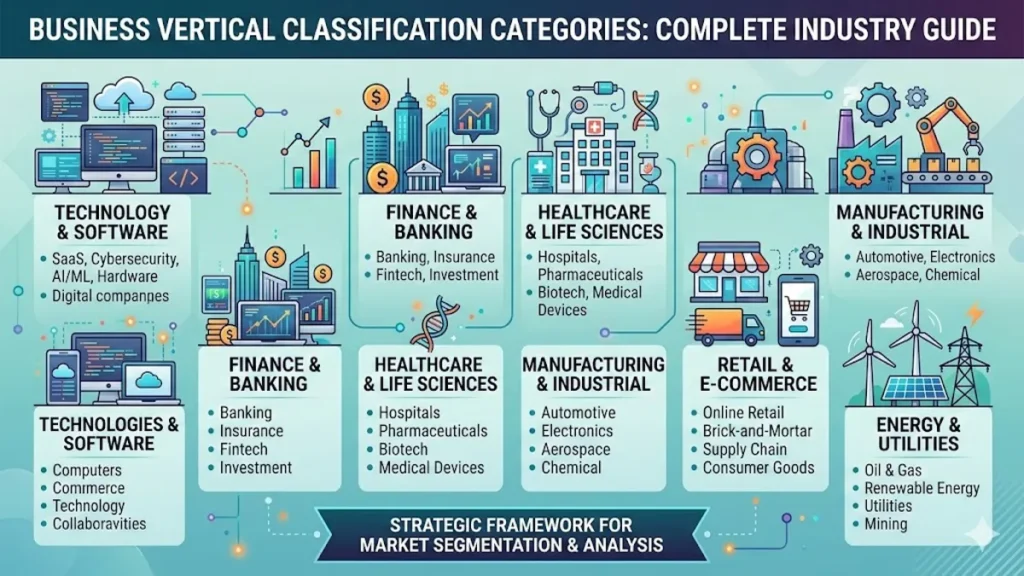

I often find that the most powerful tools shaping the global economy operate quietly behind the scenes. Business vertical classification categories are one of them. These structured systems organize companies into industries and subindustries, creating a shared language that governments, investors, researchers, and technology platforms rely on every day.
At its core, business vertical classification simply means grouping companies according to the products or services they provide. These categories help analysts track economic trends, allow regulators to monitor industries, and enable investors to compare similar companies. Without such systems, the modern economy would be much harder to measure or understand. When financial reports mention sectors like “health care,” “information technology,” or “consumer discretionary,” they are referencing formal classification structures developed over decades.
Several widely used frameworks dominate the global economy. Among the most influential are the North American Industry Classification System (NAICS), the Global Industry Classification Standard (GICS), and the Standard Industrial Classification (SIC). Each framework divides the economy into hierarchical levels, moving from broad sectors down to highly specific industries.
These classifications shape everything from stock market indexes to economic policy decisions. They influence how venture capitalists evaluate startups, how search engines categorize businesses, and how governments compile national statistics. A company’s assigned vertical can determine which competitors it is compared with, which regulatory rules apply, and how investors interpret its growth potential.
Understanding business vertical classification categories is therefore not just an academic exercise. It is a window into the structure of the global marketplace itself.
The Historical Roots of Industry Classification
The idea of grouping businesses by industry dates back to the early twentieth century, when governments began compiling large-scale economic statistics. As industrial economies expanded, policymakers needed a standardized method to measure production, employment, and trade across sectors.
One of the earliest systems was the Standard Industrial Classification (SIC), introduced in the United States in 1937. The system divided industries into numeric codes representing sectors such as manufacturing, transportation, and retail trade. These codes allowed statistical agencies to track economic activity consistently across regions and time periods.
Over time, however, the economy changed dramatically. Technology companies emerged, global trade intensified, and service industries grew far larger than traditional manufacturing sectors. The original SIC framework struggled to capture these new realities.
In 1997, the United States, Canada, and Mexico jointly adopted the North American Industry Classification System (NAICS) to replace SIC. NAICS introduced a more detailed structure and better reflected the rise of service-based industries.
Economist J. Steven Landefeld, former director of the U.S. Bureau of Economic Analysis, once emphasized the importance of these frameworks:
“Industry classification systems are the backbone of economic measurement.”
Without them, comparing industries across countries and decades would be nearly impossible.
Read: Complete Guide to Brand Name Normalization Rules for Data Consistency
Why Business Vertical Classification Matters
Business vertical classification categories play an essential role in how modern economies function. They serve as the foundation for economic statistics, financial analysis, regulatory oversight, and digital organization.
When governments publish reports on employment growth, they rely on classification systems to identify which industries are expanding or contracting. The U.S. Bureau of Labor Statistics, for example, uses NAICS codes to categorize jobs across hundreds of sectors.
Investors also depend heavily on vertical classifications. Stock market indexes frequently organize companies by sector to provide insight into economic trends. The S&P 500, for instance, groups companies according to the Global Industry Classification Standard.
These classifications also shape competition analysis. Businesses typically benchmark themselves against companies within the same vertical, evaluating performance metrics such as revenue growth, market share, and profitability.
Marketing strategist Philip Kotler has highlighted the strategic value of industry segmentation:
“Understanding industry structure is essential for identifying competitive advantage.”
In other words, classification systems do more than categorize companies. They help define the competitive landscape itself.
Major Global Classification Systems
Several major frameworks organize businesses into vertical categories. Although they differ slightly in structure and scope, they all share the same goal: creating a consistent way to describe industries.
Comparison of Major Industry Classification Systems
| Classification System | Introduced | Primary Use | Geographic Scope |
|---|---|---|---|
| SIC (Standard Industrial Classification) | 1937 | Historical economic data and legacy systems | United States |
| NAICS (North American Industry Classification System) | 1997 | Government statistics and economic reporting | North America |
| GICS (Global Industry Classification Standard) | 1999 | Stock market sector classification | Global financial markets |
| ICB (Industry Classification Benchmark) | 2005 | Financial analysis and investment research | Global markets |
The Global Industry Classification Standard (GICS), created in 1999 by MSCI and S&P Dow Jones Indices, has become particularly influential in global finance. It organizes companies into sectors such as communication services, information technology, and financials.
Each system provides a hierarchical structure that allows analysts to move from broad sectors to highly specific industries.
The Hierarchical Structure of Vertical Categories
Business vertical classification frameworks typically follow a layered hierarchy. This structure allows analysts to analyze industries at multiple levels of detail.
At the top level are broad economic sectors. Beneath them are progressively more specialized categories.
Example Hierarchy Using NAICS
| Level | Example Category |
|---|---|
| Sector | Information |
| Subsector | Telecommunications |
| Industry Group | Wireless Telecommunications |
| Industry | Cellular and Other Wireless Telecommunications |
This hierarchical design allows policymakers and researchers to zoom in on specific industries without losing sight of broader economic trends.
For example, analysts can examine employment trends across the entire information sector or focus specifically on wireless telecommunications.
Harvard Business School professor Michael Porter has noted that industry structure strongly influences company strategy:
“The structure of an industry shapes the nature of competition within it.”
Classification systems therefore provide a framework for understanding those structures.
How Vertical Classifications Shape Financial Markets
In financial markets, industry classification plays a central role in investment analysis. Portfolio managers often diversify investments across sectors to reduce risk and capture growth opportunities.
The Global Industry Classification Standard divides the economy into eleven sectors, including:
- Energy
- Financials
- Health Care
- Information Technology
- Consumer Discretionary
- Industrials
These sectors influence how analysts interpret economic cycles. For example, energy stocks may perform differently during commodity price fluctuations, while technology companies often respond to innovation trends.
Investment funds frequently track sector indexes, allowing investors to gain exposure to specific verticals. Exchange-traded funds (ETFs) focused on health care, technology, or financial services rely on classification systems to determine which companies belong in each category.
Financial historian Peter Bernstein once observed that markets require structured frameworks to function efficiently.
“Classification gives investors a map of the economic landscape.”
Without those maps, comparing companies across industries would be far more complicated.
The Role of Classification in Government Policy
Governments rely heavily on industry classification categories when designing economic policy.
Economic statistics agencies use these systems to measure employment, productivity, wages, and trade across industries. Policymakers then analyze these metrics to guide decisions about regulation, taxation, and economic development.
For example, when governments design stimulus programs during economic crises, they often target specific industries identified through classification systems. During the COVID-19 pandemic, policymakers focused relief programs on sectors such as hospitality, travel, and entertainment.
Industry classifications also shape regulatory oversight. Different industries face different compliance requirements, environmental standards, and labor regulations.
By categorizing businesses consistently, governments can enforce rules more effectively and track industry performance more accurately.
Digital Platforms and Vertical Categories
In the digital economy, classification systems play an increasingly important role. Online platforms rely on vertical categories to organize millions of businesses across directories, search engines, and advertising systems.
Search engines categorize businesses into vertical markets such as:
- Restaurants
- Legal services
- Health care providers
- Financial services
- E-commerce retailers
These categories help users find relevant results and allow advertising platforms to target specific audiences.
For example, local search platforms use vertical classifications to display industry-specific features. Restaurants may display menus and reservation systems, while medical practices display appointment scheduling tools.
Technology analyst Benedict Evans has noted that digital platforms rely on structured data to scale effectively:
“Platforms need consistent categorization to make vast amounts of information searchable.”
Vertical classification provides that structure.
Emerging Industries and the Challenge of Classification
One challenge facing classification systems is the rapid emergence of new industries. Technology innovation often creates sectors that did not exist when earlier frameworks were designed.
Consider the rise of industries such as:
- Artificial intelligence platforms
- Cryptocurrency services
- Streaming media
- Cloud computing infrastructure
Many of these sectors did not fit neatly into existing categories when they first appeared. As a result, classification systems periodically update their structures.
The Global Industry Classification Standard, for example, introduced a new communication services sector in 2018 to better reflect the convergence of telecommunications, media, and internet platforms.
Updating classification systems is essential for ensuring that economic data reflects modern realities.
The Intersection of Vertical Classification and Corporate Strategy
Industry classification does more than organize economic data. It also shapes how companies position themselves strategically.
Firms often seek to define their vertical category in ways that highlight growth potential or differentiate them from competitors. Technology companies, for instance, sometimes resist being categorized alongside traditional industries if they believe their business models are fundamentally different.
Strategic positioning within a vertical can influence investor perception, regulatory treatment, and competitive analysis.
Consultant Clayton Christensen famously argued that disruptive innovation often occurs when companies redefine the boundaries of an industry.
Classification systems must therefore remain flexible enough to accommodate evolving business models.
Takeaways
- Business vertical classification categories organize companies into structured industries and sectors.
- Systems such as NAICS, SIC, and GICS provide standardized frameworks for economic analysis.
- Governments rely on these classifications to measure employment, production, and industry growth.
- Investors use vertical categories to analyze markets and diversify portfolios.
- Digital platforms depend on structured categories to organize online business directories and advertising systems.
- Emerging technologies frequently require updates to existing classification frameworks.
- Industry categories influence competition, strategy, and regulatory oversight.
Conclusion
Business vertical classification categories rarely appear in headlines, yet they quietly structure the global economy. From government statistics to investment portfolios, these frameworks shape how industries are measured, compared, and understood.
The power of classification lies in its ability to transform complexity into clarity. By organizing millions of companies into structured categories, economists and analysts can track economic shifts that would otherwise remain hidden. Investors gain insight into sector trends. Policymakers gain the tools needed to design targeted economic policies.
At the same time, classification systems must constantly evolve. New technologies, new industries, and new business models challenge the boundaries of traditional sectors. Updating these frameworks is essential to ensure that they reflect the modern economy rather than the industrial past.
In a world defined by rapid change, the quiet architecture of classification continues to guide how we interpret markets, industries, and economic progress itself.
FAQs
What are business vertical classification categories?
Business vertical classification categories group companies based on the products or services they provide. These systems help organize industries for economic analysis, government statistics, and financial market research.
What is the NAICS classification system?
The North American Industry Classification System (NAICS) is used by the United States, Canada, and Mexico to categorize businesses into industries for statistical and economic analysis.
How does GICS differ from NAICS?
GICS is primarily used in financial markets to classify publicly traded companies into sectors for investment analysis, while NAICS is used by governments for economic statistics.
Why are industry classifications important for investors?
Industry classifications help investors compare companies within the same sector, understand economic trends, and diversify investment portfolios across industries.
How often are classification systems updated?
Major classification frameworks are periodically revised to reflect changes in the economy, such as the emergence of new technologies or industries.


