
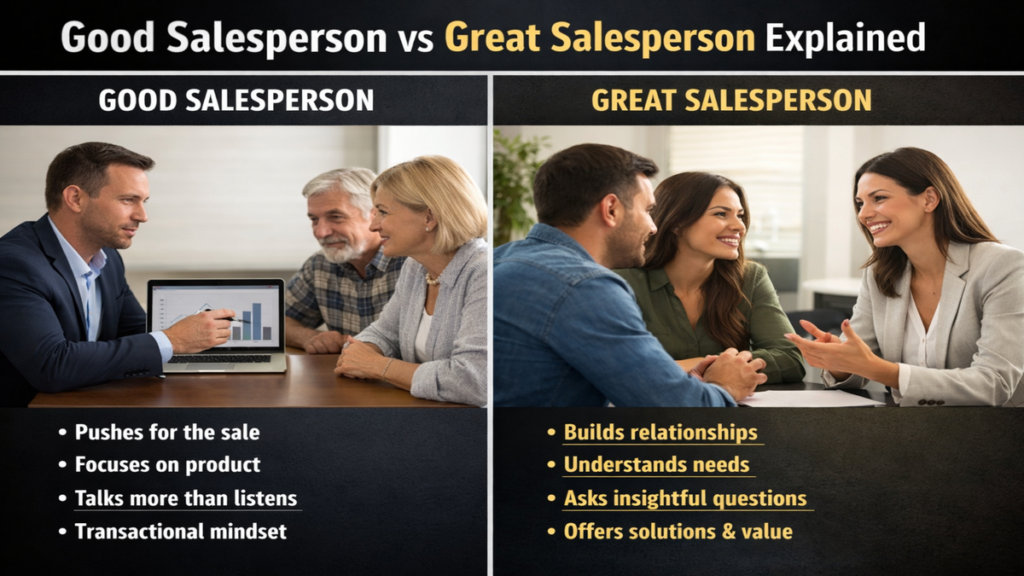

I have often noticed that most salespeople believe they are good at what they do, but very few understand what it actually takes to be great. The difference is not loud, flashy, or obvious. It hides in conversations, decisions, and small moments that compound over time. A good salesperson can close deals and meet targets. A great salesperson reshapes how customers think, builds long-term trust, and creates value that outlasts the transaction itself.
In the first hundred words of this discussion, the distinction becomes clear. Good salespeople focus on selling products. Great salespeople focus on solving problems. Good ones rely on scripts and persuasion. Great ones rely on insight, timing, and emotional intelligence. This difference is not theoretical. It directly impacts revenue, customer retention, and brand reputation.
Sales has evolved dramatically over the last two decades. Buyers are more informed, more skeptical, and less tolerant of pressure tactics. According to a 2020 report by HubSpot, 60 percent of buyers prefer not to interact with a salesperson as their primary source of information. That shift has forced a transformation in what excellence looks like.
This article explores that transformation in depth, examining behaviors, mindset, strategy, and measurable outcomes that separate the good from the truly great.
The Core Difference: Transaction vs Transformation
At the heart of the divide lies a fundamental philosophical difference. A good salesperson aims to complete a transaction. A great salesperson aims to transform the customer’s situation. This distinction shapes every action they take.
A good salesperson listens just enough to match a product to a need. A great salesperson listens deeply to uncover problems the customer may not fully understand. This difference reflects what Matthew Dixon and Brent Adamson describe in The Challenger Sale as “teaching for differentiation” (Dixon & Adamson, 2011). Great salespeople do not simply respond. They reframe.
Research from Gartner shows that customers who experience a high-quality buying journey are 2.8 times more likely to complete a large purchase with minimal regret (Gartner, 2019). That journey is rarely created by average selling behavior. It requires insight, patience, and a willingness to challenge assumptions.
The result is a shift from selling to advising. The salesperson becomes less of a vendor and more of a strategic partner. Over time, this approach compounds into trust, repeat business, and referrals, which are the true currency of long-term success.
Behavioral Contrast: Good vs Great in Practice
Below is a structured comparison that highlights the everyday behaviors separating the two levels of performance:
| Dimension | Good Salesperson | Great Salesperson |
|---|---|---|
| Focus | Closing deals | Creating value |
| Listening | Reactive | Deep, diagnostic |
| Approach | Product-centric | Customer-centric |
| Communication | Persuasive | Insight-driven |
| Objections | Handled defensively | Anticipated and reframed |
| Relationship | Short-term | Long-term partnership |
| Learning | Occasional | Continuous and deliberate |
These distinctions may appear subtle, but in practice they produce dramatically different outcomes. A salesperson who focuses on closing deals may succeed in the short term but struggle to build a sustainable pipeline. In contrast, one who prioritizes value creation often generates organic demand through trust and reputation.
Daniel Pink, in To Sell Is Human, argues that modern sales success depends on “attunement,” the ability to align with another person’s perspective (Pink, 2012). Great salespeople master this skill. Good salespeople often overlook it.
The Psychology of Trust and Influence
Trust is the invisible engine behind every successful sale. Without it, even the most compelling pitch fails. With it, even imperfect solutions can succeed.
Good salespeople attempt to earn trust through friendliness and professionalism. Great salespeople earn trust through competence and honesty. They are willing to say, “This may not be the best fit for you,” which paradoxically increases credibility.
According to Edelman’s 2022 Trust Barometer, 81 percent of consumers say trust is a deciding factor in their purchasing decisions (Edelman, 2022). This statistic underscores the importance of authenticity over persuasion.
One expert, sales strategist Jill Konrath, notes, “Customers don’t care how much you know until they know how much you care.” This statement captures a critical shift. Empathy is no longer optional. It is central to performance.
Great salespeople understand cognitive biases as well. They recognize how fear of loss, social proof, and decision fatigue influence behavior. Rather than exploiting these biases, they guide customers through them ethically, ensuring clarity rather than confusion.
Strategic Thinking: Playing the Long Game
A defining trait of great salespeople is their ability to think beyond immediate outcomes. They understand that a lost deal today can become a larger opportunity tomorrow if handled correctly.
Good salespeople often chase quotas aggressively, sometimes at the expense of relationships. Great salespeople balance urgency with patience. They know when to push and when to step back.
Harvard Business Review has documented that high-performing sales professionals spend significantly more time preparing for conversations than average performers (Rackham, 1988). Preparation allows them to ask better questions, anticipate concerns, and deliver tailored insights.
This strategic mindset extends to account management. Great salespeople map stakeholder relationships, understand organizational dynamics, and align their solutions with broader business goals. They are not selling a product. They are embedding themselves into the customer’s success.
Communication Mastery: From Pitching to Guiding
The evolution from good to great is often most visible in communication style. Good salespeople pitch. Great salespeople guide.
A pitch is about delivering information. Guidance is about shaping decisions. This requires clarity, timing, and adaptability.
Nancy Duarte, a communication expert, emphasizes that effective persuasion is not about overwhelming audiences with data but about creating a narrative that resonates (Duarte, 2010). Great salespeople use storytelling to connect emotionally while maintaining logical credibility.
They also master silence. Instead of filling every pause, they allow space for the customer to think, respond, and reveal deeper concerns. This restraint often leads to more meaningful conversations.
Another expert, Neil Rackham, whose research led to the SPIN selling methodology, found that successful sales conversations involve more questions than statements (Rackham, 1988). Great salespeople internalize this principle. They guide through inquiry, not assertion.
Metrics That Matter: Performance Beyond Quotas
While quotas remain a key measure, they do not fully capture the difference between good and great. The following table illustrates broader performance indicators:
| Metric | Good Salesperson | Great Salesperson |
|---|---|---|
| Revenue Consistency | Variable | Predictable |
| Customer Retention | Moderate | High |
| Referral Rate | Low | Strong |
| Deal Size Growth | Limited | Expanding |
| Sales Cycle Efficiency | Average | Optimized |
| Customer Lifetime Value | Moderate | Maximized |
Great salespeople consistently outperform because they focus on leading indicators such as relationship strength and customer satisfaction. These factors drive lagging outcomes like revenue.
According to Bain & Company, increasing customer retention rates by just 5 percent can increase profits by 25 to 95 percent (Reichheld & Sasser, 1990). Great salespeople understand this deeply. They prioritize retention as much as acquisition.
Adaptability in a Changing Sales Landscape
The modern sales environment is defined by rapid change. Digital tools, remote communication, and data analytics have reshaped how selling works.
Good salespeople adapt slowly. Great salespeople anticipate change. They invest in learning new technologies, understanding buyer behavior, and refining their approach continuously.
Salesforce’s 2021 State of Sales report found that high-performing sales teams are 1.5 times more likely to use data-driven insights in their processes (Salesforce, 2021). Great salespeople embrace this shift, using data to inform decisions rather than relying solely on intuition.
Adaptability also includes emotional resilience. Rejection is inevitable in sales. What separates great performers is not the absence of failure but their response to it. They analyze, adjust, and move forward without losing momentum.
Ethical Selling and Reputation
Ethics play a crucial role in distinguishing good from great. A good salesperson may occasionally prioritize short-term gains over long-term integrity. A great salesperson never does.
Reputation compounds over time. In industries where trust is critical, one unethical decision can undo years of effort. Great salespeople understand this and operate with transparency.
As Warren Buffett famously stated, “It takes 20 years to build a reputation and five minutes to ruin it.” This principle applies directly to sales.
Ethical selling also aligns with modern consumer expectations. Buyers are increasingly aware and value-driven. They expect honesty, clarity, and accountability. Meeting these expectations is not just morally right. It is strategically essential.
Takeaways
- Great salespeople focus on solving problems, not just closing deals
- Trust, built through honesty and competence, is the foundation of long-term success
- Strategic thinking and preparation differentiate top performers
- Communication shifts from pitching to guiding through insight
- Metrics like retention and lifetime value matter more than short-term quotas
- Adaptability and continuous learning are essential in modern sales
- Ethical behavior strengthens reputation and drives sustainable growth
Conclusion
I find that the distinction between a good salesperson and a great one is not defined by talent alone. It is defined by intention, discipline, and perspective. Good salespeople operate within the boundaries of their role. Great salespeople expand those boundaries, becoming advisors, problem-solvers, and trusted partners.
The gap between the two is not unreachable. It is built through deliberate practice, reflection, and a commitment to improvement. Every conversation becomes an opportunity to learn. Every lost deal becomes a lesson. Every success becomes a foundation for something greater.
In a world where buyers are more informed and selective than ever, greatness in sales is no longer optional. It is the standard for those who wish to thrive. The question is no longer whether one can sell. It is whether one can truly serve.
Click Here For More Blog Posts!
FAQs
What defines a great salesperson?
A great salesperson focuses on solving customer problems, building trust, and creating long-term value rather than simply closing transactions.
Can a good salesperson become great?
Yes. With deliberate practice, continuous learning, and a shift in mindset toward customer-centric selling, improvement is achievable.
Is emotional intelligence important in sales?
Absolutely. Understanding customer emotions and perspectives is critical for building trust and guiding decisions effectively.
Do great salespeople rely on scripts?
They may use frameworks, but they prioritize adaptability and genuine conversation over rigid scripts.
How do great salespeople handle rejection?
They treat rejection as feedback, analyze what went wrong, and refine their approach without losing confidence.
References
Dixon, M., & Adamson, B. (2011). The Challenger Sale. Portfolio Penguin.
Duarte, N. (2010). Resonate: Present Visual Stories that Transform Audiences. Wiley.
Edelman. (2022). Edelman Trust Barometer 2022. https://www.edelman.com/trust/2022-trust-barometer
Gartner. (2019). The New B2B Buying Journey. Gartner Research.
Pink, D. H. (2012). To Sell Is Human: The Surprising Truth About Moving Others. Riverhead Books.
Rackham, N. (1988). SPIN Selling. McGraw-Hill.
Reichheld, F. F., & Sasser, W. E. (1990). Zero defections: Quality comes to services. Harvard Business Review, 68(5), 105–111.
Salesforce. (2021). State of Sales Report. https://www.salesforce.com/resources/research-reports/state-of-sales/