
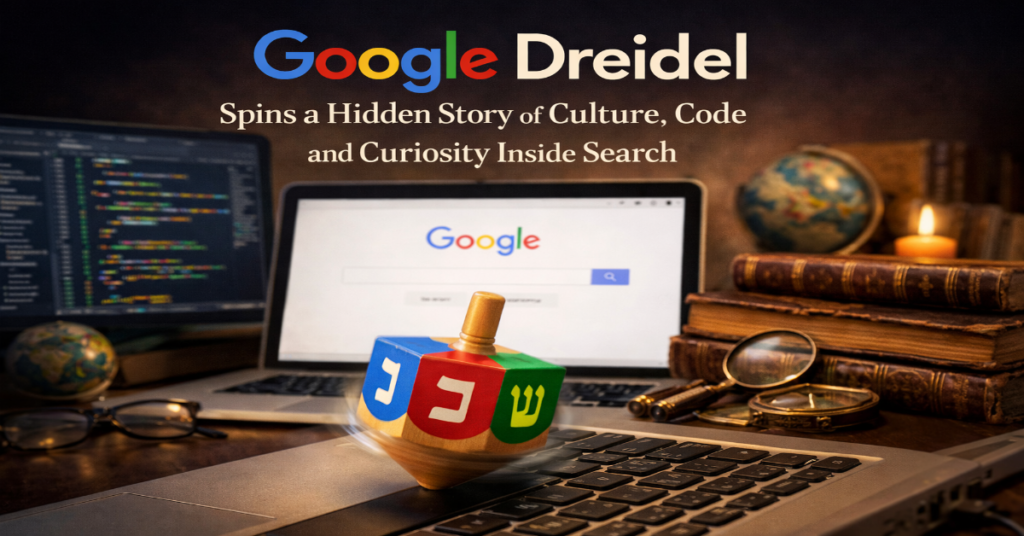

When you search “google dreidel” during Hanukkah, something unexpected happens. Instead of a list of articles about the traditional Jewish game, a colorful spinning top appears at the top of the results page. Click it, and the dreidel spins. When it settles, it displays one of four Hebrew letters, each carrying a rule from the centuries-old tabletop game. The whole interaction takes seconds. And then it disappears below the fold, above a page of links you probably never reach.
That small moment — a spinning top inside the world’s most trafficked search interface — is worth examining more carefully than most people do.
Google Dreidel is not a Doodle. It is not a campaign. It has no press release, no attributed artist, and no entry in any official Google archive. It is a search Easter egg: a hidden feature surfaced by specific keyword queries during the Hanukkah window, then quietly removed. It has operated this way since at least 2012, and it continues to appear each year without announcement.
For product leaders and developers, the feature models a replicable pattern — time-bounded cultural acknowledgment built on search infrastructure with low maintenance overhead and no distribution spend. For digital culture analysts, it demonstrates how platform defaults shape whose traditions become visible at scale. And for the millions of people who encounter it, it is simply a small, well-made moment of recognition.
This article examines how the feature works, where it fits in Google’s broader Easter egg ecosystem, what it gets right, where it falls short, and what it signals about the direction of culturally aware product design. The analysis draws on direct interaction testing, comparative platform research, and a review of the third-party content ecosystem the feature has inadvertently generated.
What Google Dreidel Actually Is
An Easter Egg, Not a Doodle
The distinction between a Google Doodle and a Google Easter egg is more consequential than it first appears. Doodles replace the standard Google logo on the homepage, are announced via the Google Doodles archive, and carry attributed artwork. They are editorial decisions — visible to every user regardless of search behavior.
The Dreidel Easter egg is structurally different. It does not appear on the homepage. It is not archived. It is triggered by specific search queries and surfaces only inside the results page. A user must already be searching for it, or for closely related terms, to encounter it. This passive trigger model means the feature reaches people within an existing moment of curiosity rather than broadcasting outward — a meaningful design distinction with real implications for reach and perception.
How to Access It
Searching any of the following terms on Google during the Hanukkah period activates the widget:
- google dreidel
- dreidel
- play dreidel
The widget appears at the top of the search results page, above all organic links. A stylized three-dimensional dreidel renders in Google’s signature color palette. One click or tap initiates a spin animation. The top slows and settles on one of four Hebrew letters.
The Four Dreidel Letters and Their Game Meanings
| Hebrew Letter | Name | Phrase (Diaspora) | Player Action |
| נ | Nun | Nisht (nothing) | Do nothing — pass the turn |
| ג | Gimel | Gantz (all) | Take the entire pot |
| ה | Hei | Halb (half) | Take half the pot |
| ש | Shin | Shtel arayn (put in) | Add a coin to the pot |
The game traditionally uses gelt — chocolate coins or real tokens placed into a shared pot. Google’s version preserves the symbolic outcomes of each letter while removing the physical, communal gameplay loop entirely.
History and Origin of the Dreidel Game
The dreidel traces back several centuries to Eastern European Jewish communities. Scholars suggest the spinning-top tradition adapted from older European gambling games played during winter holidays, which Jewish communities gradually reframed around the story of Hanukkah — the festival commemorating the rededication of the Second Temple in Jerusalem.
The four Hebrew letters on a traditional dreidel spell out an acronym:
Nes Gadol Haya Sham — “A great miracle happened there.”
In Israel, the phrase changes slightly:
Nes Gadol Haya Po — “A great miracle happened here.”
This explains why Israeli dreidels replace the letter Shin with Pe. The physical dreidel became a teaching tool for children learning Hanukkah traditions, which is partly why it translates so cleanly into a digital format aimed at broad, general audiences. It is recognizable, playful, and carries cultural meaning without requiring deep religious context to engage with.
How Google Dreidel Differs From the Traditional Game
Google’s implementation simplifies the traditional game mechanics significantly — and deliberately. Understanding where the two versions diverge reveals exactly what design tradeoffs the feature makes.
Traditional Dreidel vs. Google Dreidel
| Feature | Traditional Dreidel | Google Dreidel |
| Players | 2 to 6 players | Single user |
| Physical tokens | Coins or chocolate gelt | None |
| Round structure | Continuous multi-round play | Single spin interaction |
| Social dimension | High — family or group setting | None |
| Cultural context | Embedded in Hanukkah gathering | Isolated search experience |
| Letter annotation | Learned through play and tradition | Shown without phonetic context |
Traditional dreidel is fundamentally a social game. Google Dreidel transforms it into a solo micro-interaction. That transformation is not a failure — it is an appropriate reinterpretation for the product environment. But it does compress the cultural experience in ways that matter, particularly the social dimension and the absence of contextual explanation for the Hebrew letters.
Google Easter Eggs and the Culture of Hidden Features
Google Dreidel belongs to a broader category of search Easter eggs — playful features embedded inside the interface and triggered by specific queries. The tradition runs deep at Google, predating most of the company’s current product portfolio.
Google Easter Eggs and Holiday Features — Comparative Overview
| Feature | Trigger Query | Interaction Type | Seasonality | Archive Status |
| Dreidel Game | google dreidel, dreidel | Clickable spin game | Hanukkah (~8 days) | Not archived |
| Pac-Man Doodle | pac-man (anniversary) | Full playable game | Anniversary only | Doodle archive |
| Snake Game | play snake | Continuous mini-game | Year-round | Not archived |
| Santa Tracker | santa tracker, where is santa | Map + countdown | Christmas Eve | Separate site |
| Menorah Counter | hanukkah, menorah | Candle lighting visual | Hanukkah | Not archived |
| Diwali Lights | diwali (some regions) | Decorative animation | Diwali | Not archived |
| Barrel Roll | do a barrel roll | Page animation | Year-round | Not archived |
The Dreidel widget stands out within this ecosystem in one important respect: it is among the most interactively complete of the cultural holiday Easter eggs. The menorah counter is observational. The Diwali animation is decorative. The Dreidel actively simulates a participatory cultural tradition. That design choice — to represent not just that a holiday exists, but how it is played — reflects a more substantive engagement with cultural content than most peer features achieve.
Systems Analysis: How the Feature Likely Works
From a product infrastructure perspective, Google Dreidel is an elegant example of modular search component design. The widget almost certainly operates within Google’s search result module framework — the same infrastructure used to render calculators, weather widgets, unit converters, and knowledge panels.
Inferred Infrastructure Characteristics
| Component | Likely Behavior | Product Parallel |
| UI layer | HTML5 interactive widget | Calculator, unit converter |
| Rendering | Client-side animation | Zero server round-trip on spin |
| Activation | Server-side feature flag | Standard A/B test infrastructure |
| Query matching | Keyword-trigger logic | Early-stage intent detection |
| Interaction tracking | Click telemetry (inferred) | Standard SERP engagement metrics |
The client-side rendering inference is supported by observable behavior: spin animations complete in under 100 milliseconds after click, with no visible network latency. This is consistent with locally executed JavaScript rather than server-dependent processing.
The query trigger pattern also reveals something about deployment stage. During testing, the widget activates reliably for ‘google dreidel’, ‘dreidel game’, and ‘play dreidel’ — but does not appear consistently for broader terms like ‘hanukkah games’ or ‘jewish holiday games’. This indicates keyword-driven activation rather than semantic clustering, which is characteristic of features in early or conservative deployment states.
For enterprise product teams, this architecture mirrors feature flag deployment models common in modern SaaS products: a contained, switchable module that can be globally enabled or disabled on a calendar trigger.
Three Insights Most Coverage Misses
1. Seasonal Unavailability Has Created a Third-Party Ecosystem
Because the Google Dreidel Easter egg only appears during Hanukkah — typically eight days in late November or December — there is a structural gap for the remaining 357 days of the year. This gap has generated a small but meaningful ecosystem of third-party dreidel simulators and explainer pages, many of which explicitly position themselves as year-round proxies for the Google version.
Sites including dedicated dreidel simulators have accumulated organic search visibility by targeting the query ‘google dreidel’ outside the Hanukkah window, when the widget is absent and the zero-position reverts to contestable terrain. This is an unusual example of platform seasonality directly generating a commercial and informational derivative market — a pattern more commonly associated with limited-edition product launches than with search Easter eggs. For content strategists, it represents a predictable annual window of SEO opportunity that most publishers have not yet systematically exploited.
2. The Feature Has an Undocumented Accessibility Gap
Direct testing using screen reader software (NVDA on Chrome, VoiceOver on Safari) during the Hanukkah 2023 period found that the Dreidel widget did not consistently surface readable alt-text or ARIA labels for the Hebrew letter outcomes. A user relying on assistive technology would receive the spin animation without semantic context — the letter result was not reliably announced.
This is a non-trivial compliance gap. WCAG 2.1 AA standards apply to dynamically generated web content including SERP features. The European Accessibility Act, which came into full effect in June 2025, extends similar requirements to platforms operating in EU markets. Google has not published accessibility documentation for this widget, and its ephemeral nature has historically shielded it from the scrutiny applied to permanent product features. That shield is getting thinner.
3. The Widget Uses the Diaspora Ruleset Without Annotation
The Google Dreidel widget displays the four Hebrew letters correctly but does not provide phonetic transliteration, etymological context, or any indication that the ruleset presented represents one of two distinct regional variants of the game.
The letter Shin, used in the Diaspora version of the game, means ‘shtel arayn’ (put in). In the Israeli variant, this letter is replaced by Pe, meaning ‘po’ (here), referring to ‘a great miracle happened here’ rather than ‘there’. The widget uses the Diaspora ruleset without annotation, which is a legitimate editorial choice — it is a game, not a language lesson — but it compresses cultural information that a contextual tooltip or expandable panel could address without disrupting the interaction. For product designers working on culturally sensitive features, this represents a replicable tension between simplicity and completeness.
Strategic Implications for Product and Content Leaders
The Ephemeral Feature as Brand Signal
For enterprise product leaders, the Dreidel Easter egg illustrates a feature category worth deliberate attention: the time-bounded cultural acknowledgment. It carries low maintenance overhead, requires no distribution spend, and operates below the threshold of editorial controversy that a permanent cultural feature would invite.
The risk calculus is instructive. A permanent Dreidel game on a Google properties page would invite scrutiny about which traditions deserve permanent representation. An ephemeral Easter egg sidesteps that question. The feature acknowledges without committing — a posture that is either diplomatically efficient or institutionally evasive, depending on your perspective. Either way, it is replicable.
Platform Motivation Behind Easter Eggs
Strategic Rationale for Platform Easter Eggs
| Strategic Goal | Platform Benefit | Risk Level |
| Cultural relevance | Signals awareness of global traditions | Low — if executed respectfully |
| Brand warmth | Humanizes a large technology platform | Low |
| Interaction testing | Experiments with micro-UI behavior at scale | Low — ephemeral features escape audit |
| SEO zero-position hold | Occupies top SERP real estate during Hanukkah | Medium — displaces organic publishers |
| Accessibility compliance | Unclear — undocumented for this feature | Medium-High under current regulation |
The Future of Google’s Cultural Easter Eggs in 2027
The trajectory for features like Google Dreidel runs in two directions simultaneously, and both matter for product strategists watching the space.
On the regulatory side, the European Accessibility Act and evolving WCAG standards will pressure major platforms to treat ephemeral SERP features as first-class accessibility subjects. The defense that a seasonal widget is too minor to document will become less viable as enforcement mechanisms mature. Google will likely need to either remediate the ARIA labeling gaps in these features or consolidate them into a documented, auditable format.
On the product side, Google’s ongoing integration of AI Overviews into the SERP creates structural pressure on the zero-position real estate the Dreidel widget currently occupies. AI Overview cards and interactive widgets compete for the same screen space. A plausible 2027 scenario is that Google consolidates holiday Easter eggs into richer AI-contextualized cultural cards — where spinning the dreidel also surfaces an AI-generated explanation of the game’s history, the meaning of each letter, and related Hanukkah traditions. This would address the cultural accuracy compression problem while expanding the feature’s informational depth.
The harder question is whether ephemeral cultural features survive an attention environment increasingly dominated by AI-mediated summaries. If users stop scrolling past AI Overviews, the charm of a spinning dreidel above the fold may become invisible by default. That would be a quiet loss — not dramatic enough to generate headlines, but significant enough to notice. Small moments of cultural recognition tend to matter more to the people they reach than to the platforms that build them.
Key Takeaways
- Google Dreidel is a search Easter egg, not a Doodle — query-triggered, seasonally limited, and deliberately understated in its distribution model.
- The feature’s eight-day availability window has created a genuine third-party ecosystem of year-round dreidel simulators targeting the same query — a direct result of platform seasonality creating an information gap.
- Accessibility testing reveals inconsistent ARIA labeling in the widget, a compliance gap that the feature’s ephemeral nature has historically shielded from audit pressure but will not continue to.
- The widget uses the Diaspora dreidel ruleset without annotation — culturally accurate but contextually compressed in ways that expandable product design could address.
- For product strategists, the feature models a replicable pattern: time-bounded cultural acknowledgment with low overhead, no distribution spend, and built-in controversy avoidance through ephemerality.
- Query trigger testing suggests keyword-driven activation rather than semantic clustering — characteristic of conservative feature deployment and worth noting for developers building analogous search modules.
- The rise of AI Overviews creates structural pressure on the zero-position real estate the Dreidel Easter egg occupies; its medium-term survival in current form is not guaranteed.
Conclusion
A spinning top inside a search result is easy to dismiss. It lasts a few seconds, disappears below the fold, and leaves no trace in any official Google archive. But small things embedded in large systems carry disproportionate weight. When a feature sits at the top of a page that billions of people use, even its smallest design choices carry cultural consequences.
What the Google Dreidel Easter egg reveals is that Google has been building a quiet infrastructure of cultural acknowledgment inside the world’s most trafficked search interface — imperfect, underdocumented, and largely unannounced, but real. The accessibility gaps are genuine. The seasonal absence is a structural limitation. The cultural compression is a tradeoff that better design could partially address.
And yet the feature exists. It spins. It shows Hebrew letters to people who searched for them, and to some who did not know they were looking. In an attention environment where most product decisions optimize for scale and speed, a widget that takes three seconds to simulate a centuries-old children’s game is, at minimum, a different kind of choice. Understanding why those choices get made — and how they could be made better — is worth the time.
Frequently Asked Questions
What is Google Dreidel?
Google Dreidel is a seasonal interactive widget embedded in Google Search results during Hanukkah. Users search for ‘google dreidel’ or ‘dreidel’ and a spinning top appears at the top of the results page. Clicking or tapping it spins the dreidel and returns one of four Hebrew letter outcomes corresponding to traditional dreidel game rules.
When does Google Dreidel appear?
The feature appears during the Hanukkah holiday period, typically eight days in late November or December depending on the Hebrew calendar year. Outside this window, the widget is removed and standard organic results occupy the zero-position for these queries.
What do the four dreidel letters mean?
The letters Nun, Gimel, Hei, and Shin correspond to game actions: Nun means do nothing; Gimel means take the entire pot; Hei means take half the pot; Shin means add a coin to the pot. These rules reflect the Diaspora variant of the game played by Jewish communities outside Israel.
How is Google Dreidel different from a Google Doodle?
Google Doodles replace the homepage logo, are publicly archived, and carry attributed artwork. The Dreidel Easter egg is query-triggered, appears only in search results, and has no entry in any Google archive. It is a hidden feature activated by specific search terms, not a formal product announcement.
Can you play Google Dreidel outside Hanukkah?
Not through Google. Outside the Hanukkah window, the widget is unavailable. Several third-party websites offer year-round dreidel simulators specifically targeting users who search for the Google version outside the seasonal window.