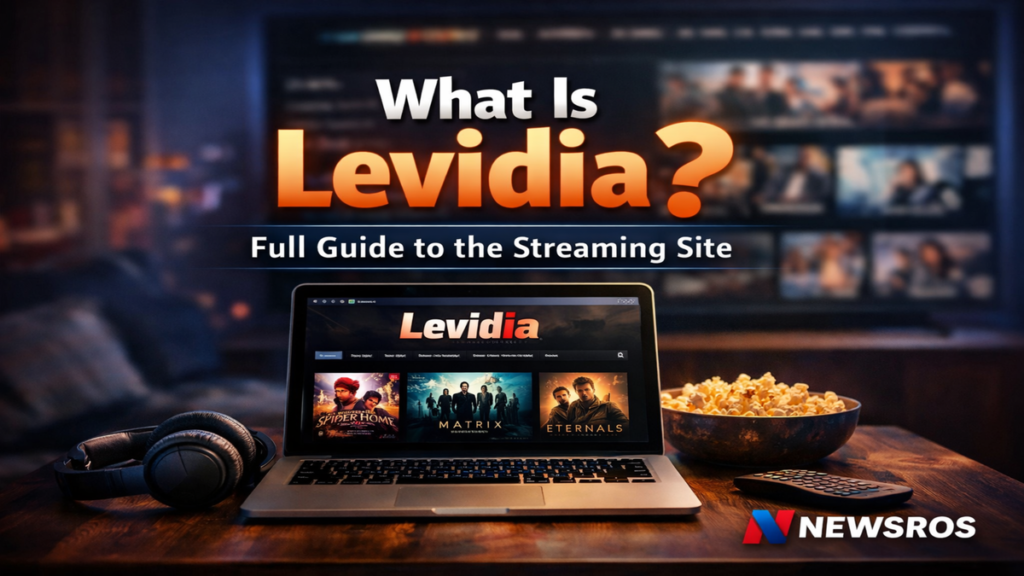

I first encountered the name Levidia while researching how people actually watch movies online today. The name appeared repeatedly across search engines, forums, and social media conversations where users traded tips about finding films without paying subscription fees. In simple terms, Levidia refers to a free movie streaming website that allows users to watch films and television shows online without creating an account or paying for access. Visitors typically search for a title, click a link, and begin streaming almost instantly.
That convenience explains why the platform has gained widespread attention among internet users seeking alternatives to paid streaming services. In a media landscape increasingly dominated by subscription platforms such as Netflix, Amazon Prime Video, and Disney+, many viewers feel overwhelmed by the number of services required to watch different films or shows. Free streaming sites like Levidia promise something simpler: a single destination where viewers can access a wide catalog without monthly costs.
But Levidia’s story goes far beyond convenience. Its popularity reflects a deeper transformation in the digital media economy. The platform exists at the intersection of technological innovation, copyright disputes, and global entertainment demand. Some people view it as a practical solution to fragmented streaming catalogs, while others see it as a clear example of online piracy. Governments and entertainment companies continue to debate how to regulate such platforms, yet they remain widely accessible through constantly changing domains and mirror sites.
Understanding Levidia therefore requires examining not only the website itself but also the broader evolution of digital streaming, internet culture, and the shifting expectations of modern audiences.
The Evolution of Free Movie Streaming on the Internet
When I trace the origins of free movie streaming platforms, the story begins long before Levidia appeared online. During the early 2000s, online piracy largely revolved around file-sharing networks such as Napster and BitTorrent. Users downloaded entire movies or television episodes, often waiting hours for large files to finish transferring.
As broadband internet speeds improved, a new model emerged. Instead of downloading files, viewers could watch content instantly through browser-based video players. This transition fundamentally changed how piracy operated online. Streaming sites began organizing huge libraries of films and television shows that could be watched with a single click.
Platforms such as Putlocker, 123Movies, and SolarMovie became extremely popular during the 2010s. These sites offered extensive catalogs that rivaled legitimate streaming platforms, often including newly released films shortly after their theatrical debut. However, copyright enforcement efforts led to frequent shutdowns. Authorities in multiple countries targeted these sites through domain seizures and legal actions.
Yet each closure seemed to generate new alternatives. Levidia emerged in this environment as one of many successors that filled the void left by earlier platforms. Like its predecessors, it adopted a familiar formula: a simple search interface, organized content categories, and embedded streaming players that allowed immediate viewing.
Media researchers often describe this ecosystem as a “shadow streaming economy.” Ramon Lobato, a scholar who studies global media distribution, has written that piracy platforms frequently develop in response to limitations within legal distribution systems. According to Lobato, when entertainment becomes difficult to access legally due to pricing, regional licensing restrictions, or fragmented catalogs, informal networks often emerge to meet audience demand.
Levidia represents a modern example of that pattern. The platform did not invent free streaming, but it reflects how resilient and adaptable the model has become.
How the Levidia Platform Operates
From a technical perspective, Levidia functions more like an index than a traditional video hosting service. When I examined how similar platforms operate, I found that most of them do not store the films directly on their own servers. Instead, they aggregate links to video files hosted on third-party streaming servers scattered across the internet.
This architecture helps the site maintain large libraries without the massive storage costs associated with hosting thousands of high-definition films. It also creates a layer of separation between the platform and the actual video files. The site essentially acts as a directory that connects viewers with external video hosts.
Visitors arriving on a Levidia page typically encounter a layout resembling legitimate streaming platforms. There is usually a search bar at the top of the page, along with categories such as action, drama, thriller, science fiction, and animation. Some versions of the site include sections highlighting trending movies, newly added titles, or popular television series.
Once a viewer selects a film, the page loads a streaming player embedded from another hosting service. If one video link fails or becomes unavailable, alternative sources may appear as backup players. This redundancy ensures that viewers can continue watching even if individual hosting servers remove the file.
Technology analyst Brett Danaher has described these platforms as hybrid search engines and media catalogs. They do not necessarily distribute the content themselves but instead organize links that guide viewers toward available streams. This distinction has become central to debates about the legal responsibility of such websites.
Another notable feature is the absence of user accounts. Unlike subscription platforms that require sign-ups, free streaming sites often eliminate registration entirely. The lack of login systems allows users to watch content anonymously, which many viewers perceive as a major advantage.
The Types of Content Available on Levidia
One reason Levidia has attracted significant attention is the breadth of its content library. While the exact catalog varies across different mirror domains, the platform generally offers a wide range of movies and television series spanning multiple decades.
Viewers can often find newly released films, classic cinema, and international productions in the same catalog. The platform also includes episodic television series, allowing audiences to stream multiple seasons without navigating different streaming services.
This diversity mirrors the expectations created by modern streaming culture. Audiences now expect to search for any title and immediately find it available online. When a film disappears from subscription platforms due to licensing changes, viewers frequently look for it elsewhere.
Film industry analyst Amanda Lotz has argued that the streaming era has fundamentally reshaped audience expectations. In her research on digital television distribution, she explains that modern viewers expect “immediate, on-demand access to nearly everything in the media archive.” When that expectation is unmet by legal services, alternative platforms quickly gain traction.
Free streaming websites therefore function partly as discovery engines. Many viewers use them to watch films unavailable in their region or temporarily missing from paid services. This ability to aggregate content from many different sources makes platforms like Levidia appealing to audiences seeking convenience.
Legal Controversies Surrounding Levidia
The legal status of Levidia remains one of the most debated aspects of the platform. Copyright law generally grants film studios and distributors exclusive rights to reproduce and distribute their content. Streaming or sharing copyrighted works without authorization can therefore constitute copyright infringement in many jurisdictions.
However, free streaming websites often operate in a legal gray zone. Because they frequently link to external video hosts rather than storing files themselves, operators sometimes argue that they are not directly distributing copyrighted material. Instead, they claim to provide links to content hosted elsewhere.
Courts in different countries have reached varying conclusions regarding this argument. In some cases, authorities have ruled that indexing or linking to infringing material can still violate copyright law. Governments and internet service providers have also attempted to block access to certain piracy sites by restricting their domains.
Despite these enforcement efforts, the decentralized nature of the internet makes permanent shutdowns difficult. When one domain is removed, another often appears with identical content. This pattern has led experts to describe piracy enforcement as a constant technological arms race.
Researchers studying piracy networks emphasize that the issue extends beyond individual websites. The broader challenge lies in balancing intellectual property protection with global access to media content. Streaming rights vary widely across regions, meaning that a film legally available in one country might be inaccessible in another.
Levidia’s existence therefore reflects a larger structural problem within the entertainment industry rather than a single rogue platform.
Why Audiences Continue to Use Free Streaming Sites
While exploring discussions about Levidia online, I noticed a recurring theme: many users do not view themselves as pirates. Instead, they describe using free streaming sites because legitimate options feel limited or expensive.
The cost of streaming subscriptions has increased significantly over the past decade. Many households now maintain multiple subscriptions to access different studios’ catalogs. For viewers on tight budgets, paying for several services simultaneously may not be feasible.
Another factor is content fragmentation. Major studios increasingly reserve their films for proprietary streaming platforms. A movie produced by Disney may appear exclusively on Disney+, while a Warner Bros. release might stream only on Max. This fragmentation means that audiences must navigate multiple platforms to watch a wide variety of films.
Technology journalist Ernesto Van der Sar, founder of the piracy research website TorrentFreak, has noted that piracy often correlates with availability rather than price alone. According to his analysis, audiences frequently turn to piracy when legal access becomes inconvenient or geographically restricted.
Levidia offers a solution to these frustrations by providing a single interface where viewers can search for nearly any title. The convenience of instant access without subscriptions or sign-ups explains why such platforms continue attracting millions of visitors worldwide.
Security Risks and Safety Concerns
Although free streaming sites promise easy entertainment access, they also raise important security concerns. Because these platforms operate outside traditional regulatory frameworks, they often rely on advertising networks that generate revenue through pop-up ads or redirects.
Some advertisements displayed on such sites may lead to suspicious downloads or deceptive pages designed to collect personal information. Cybersecurity experts therefore warn users to exercise caution when visiting unknown streaming domains.
Common risks include malware downloads disguised as video players, phishing attempts requesting personal data, and intrusive advertisements that redirect users to unrelated websites. These threats do not appear on every streaming site, but they are common enough to warrant caution.
Security professionals generally recommend several protective measures. Keeping antivirus software updated can help detect malicious downloads. Ad-blocking browser extensions may reduce exposure to harmful advertisements. Avoiding suspicious download prompts is also critical, as legitimate streaming platforms rarely require additional software installations.
Another consideration involves privacy. Free streaming sites often lack transparent privacy policies regarding user data collection. Because visitors typically access the platform without accounts, tracking may occur through browser cookies or advertising networks rather than formal user profiles.
Understanding these risks is essential for anyone considering using such platforms.
The Role of Domain Changes and Mirror Sites
One characteristic feature of Levidia and similar platforms is the constant movement between web domains. Users searching for the site may encounter different addresses ending in extensions such as .ch, .sbs, or others.
This pattern results from the ongoing enforcement actions taken against piracy websites. When authorities or hosting providers shut down a domain, site operators often launch a new one that mirrors the same interface and content. These mirror sites allow users to continue accessing the platform despite disruptions.
The migration of domains also reflects the decentralized structure of piracy networks. Video files are hosted on multiple servers, and site databases can often be replicated quickly. As a result, shutting down a single website rarely eliminates the entire ecosystem.
For users, this constant movement can create confusion. Searches for “Levidia not working” frequently spike whenever a domain becomes inaccessible. New URLs then circulate through forums, social media posts, or search engine results.
The resilience of these networks demonstrates how difficult it is to control information distribution on the modern internet.
Cultural Implications of Free Streaming
Looking beyond technical details, Levidia highlights an important cultural shift in how audiences consume entertainment. The internet has fundamentally altered expectations regarding access to information and media. People increasingly assume that movies, music, and television should be instantly available online.
Streaming platforms accelerated this expectation by introducing massive on-demand libraries. However, when content is divided across multiple services or restricted by region, the promise of universal access breaks down.
Free streaming sites fill that gap by offering an unofficial archive of global entertainment. They often host films that are out of print, unavailable in certain countries, or temporarily absent from mainstream platforms.
Some scholars argue that piracy networks inadvertently preserve cultural works that might otherwise disappear from public view. Others emphasize the harm piracy can cause to creators and distributors who rely on licensing revenue.
The debate therefore extends beyond legality into broader questions about cultural access and digital ethics. Should audiences always pay for content, even when it is difficult to obtain legally? Or does the internet’s open architecture inevitably encourage alternative distribution channels?
Levidia sits at the center of this unresolved discussion.
Conclusion
I began researching Levidia out of curiosity about a frequently searched website name. What I discovered was not merely a streaming platform but a window into the evolving dynamics of digital media.
The platform reflects the persistent demand for easy, affordable access to entertainment in a world where streaming services have multiplied and fragmented film libraries across numerous platforms. While Levidia offers convenience, it also raises complex legal, ethical, and security questions that remain unresolved.
Governments and media companies continue attempting to control piracy through domain blocks and legal actions. Yet the internet’s decentralized structure makes it extraordinarily difficult to eliminate such platforms entirely. As long as audiences desire instant access to films without financial barriers, new websites will likely emerge to meet that demand.
Levidia’s future remains uncertain. The domain may change, the interface may evolve, or the site may eventually disappear altogether. But the underlying forces that produced it—technological innovation, global media demand, and the tension between access and ownership—are unlikely to vanish.
Understanding Levidia therefore means understanding the broader transformation of entertainment itself. The internet has rewritten the rules of distribution, and the story of free streaming is still unfolding.
Read: Koora Live: Football Streaming Explained
FAQs
What is Levidia?
Levidia is a free online streaming website where users can watch movies and TV shows without paying a subscription or creating an account. It typically aggregates content from external video hosts.
Is Levidia legal?
The legality of Levidia varies by jurisdiction. Many experts consider it to operate in a copyright gray area because it links to or embeds content that may not be licensed.
Do you need to create an account to use Levidia?
Most versions of the platform allow users to watch content without registration, which is part of its appeal to viewers seeking quick access.
Is Levidia safe to use?
Safety depends on the domain being used. Some mirror sites contain pop-ups or advertisements that may pose security risks if clicked.
Why does the Levidia website sometimes stop working?
Free streaming sites often change domains or experience takedowns. When this happens, mirror sites or new URLs may appear.