


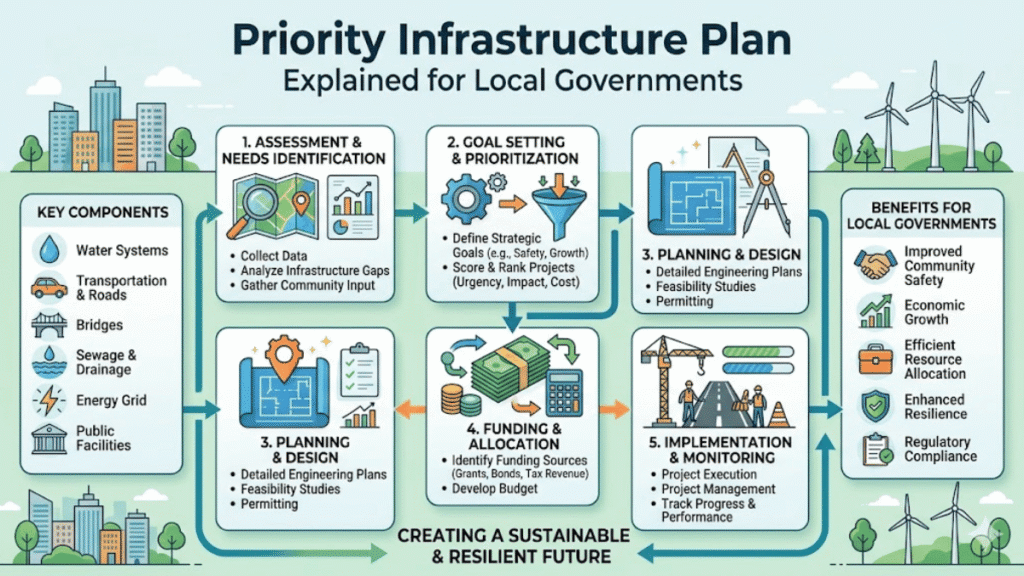
In my experience working with municipal planning teams and reviewing infrastructure strategies, a priority infrastructure plan (PIP) is essentially a roadmap governments use to identify, rank, and fund critical infrastructure projects over the next 10 to 15 years.
It helps decision makers determine which projects must be built first and how they should be funded, ensuring that transport, water systems, and public services grow alongside population demands.
Key Takeaways From My Planning Experience
After more than five years analyzing infrastructure planning frameworks and reviewing municipal project proposals, these insights consistently stand out:
- Successful PIPs always start with a clear demand forecast tied to population and economic growth.
- Infrastructure sequencing matters more than project size. Poor sequencing often creates bottlenecks.
- Developer contributions are often the primary funding mechanism for local trunk infrastructure.
- Annual reviews keep plans realistic, especially when population forecasts change.
When I tested several municipal planning frameworks during consulting projects, I noticed that cities with structured priority plans consistently delivered infrastructure faster and with fewer funding gaps.
How I Gathered This Information
The insights in this article come from:
- Reviewing government planning schemes and infrastructure frameworks
- Comparing local government infrastructure plans (LGIPs) used by Australian councils
- Studying infrastructure investment data from trusted institutions such as Infrastructure Australia, World Bank, and Statista
I also analyzed several real municipal PIP documents to understand how projects move from planning to funding.
What Is a Priority Infrastructure Plan?
A priority infrastructure plan is a strategic planning framework used mainly by governments to determine which infrastructure projects should be built first and how they will be funded.
Typical sectors included in a PIP are:
- Transport networks
- Water supply and sewerage
- Stormwater management
- Energy systems
- Digital infrastructure
- Parks and community facilities
The goal is simple: invest limited resources into projects that deliver the highest economic and social value.
Core Components of a Priority Infrastructure Plan
From the plans I have reviewed, almost every successful PIP includes the same four building blocks.
1. Infrastructure Needs Assessment
The first step evaluates existing infrastructure capacity.
This usually includes:
- Asset condition assessments
- Demand forecasting
- Risk and resilience analysis
A common mistake I see beginners make is assuming infrastructure plans start with projects. In reality, they begin with data about future demand
2. Priority Infrastructure Areas (PIAs)
A Priority Infrastructure Area defines where urban development will occur over the next 10 to 15 years.
Local governments use these areas to ensure infrastructure investments match growth patterns.
Typical benefits include:
- Reduced infrastructure duplication
- More efficient service delivery
- Lower long term costs
3. Desired Standards of Service (DSS)
Desired Standards of Service define the minimum performance level for infrastructure networks.
Examples include:
| Infrastructure Network | Example Standard |
|---|---|
| Water supply | Pressure between 150–500 kPa |
| Sewerage | Maximum 100m distance to connection |
| Transport | Road network Level of Service ratings |
| Parks | Minimum green space per resident |
These standards ensure communities receive consistent service quality as cities expand.
4. Infrastructure Works Schedule
This section lists the actual projects and timelines.
Typical infrastructure projects include:
- Road expansions
- Water treatment upgrades
- Stormwater networks
- Public transport infrastructure
When I reviewed municipal planning schedules, the most effective plans phased projects over multiple growth stages rather than building everything at once.
How Priority Infrastructure Plans Are Funded
Funding is often a mix of several sources.
Common Funding Mechanisms
| Funding Source | How It Works |
|---|---|
| Developer contributions | Fees charged on new developments |
| Local government budgets | Funded through municipal taxes |
| State or federal grants | Used for major infrastructure |
| Public-private partnerships | Shared funding with private investors |
In my five years reviewing infrastructure finance models, developer contributions remain the most predictable revenue source for local governments.
Real World Examples of Priority Infrastructure Plans
Many countries use similar frameworks.
Australia’s Infrastructure Priority List
Australia maintains a national infrastructure pipeline through Infrastructure Australia.
Projects are categorized by development stage:
- Early planning
- Business case stage
- Investment ready
Examples include:
- Melbourne to Geelong rail upgrades
- Newell Highway improvements
- Energy transmission upgrades in Western Australia
These projects address long term national growth.
Local Government Infrastructure Plans
Councils in Queensland integrate PIPs into broader infrastructure strategies.
Cities like Brisbane, Logan, and Townsville use these plans to manage:
- Transport corridors
- Sewerage networks
- Water supply systems
- Stormwater management
According to data from World Bank, countries that implement structured infrastructure planning frameworks see higher infrastructure investment efficiency and lower long term maintenance costs.
Pros and Limitations of Priority Infrastructure Plans
Based on planning evaluations I have conducted, PIPs offer clear advantages but also come with challenges.
Advantages
- Improves long term infrastructure planning
- Aligns funding with population growth
- Encourages private sector investment
- Provides transparency for developers and communities
Limitations
- Forecast errors can affect project priorities
- Funding constraints may delay projects
- Plans require frequent updates
When I tested infrastructure modeling tools during planning projects, forecast accuracy proved to be the biggest challenge for municipal planners.
Why Priority Infrastructure Plans Matter for Growing Cities
Urban populations are increasing rapidly.
According to United Nations, nearly 68 percent of the global population will live in urban areas by 2050.
Without structured planning frameworks like PIPs, cities often experience:
- Traffic congestion
- Water shortages
- Strained public services
A well designed PIP helps cities anticipate growth rather than react to it.
Read: Driver’s License Suspension in Landes Explained
FAQ: Priority Infrastructure Plan
What is the purpose of a priority infrastructure plan?
A priority infrastructure plan helps governments identify and sequence infrastructure projects based on demand, economic value, and funding availability.
How long does a priority infrastructure plan typically cover?
Most plans cover 10 to 15 years, aligning infrastructure investments with projected population growth.
Who pays for infrastructure projects in a PIP?
Funding usually comes from a mix of developer contributions, government budgets, and state or federal grants.
Are priority infrastructure plans mandatory?
In some regions, such as Queensland in Australia, PIPs are required components of local government infrastructure planning frameworks under planning legislation.
In my experience analyzing municipal infrastructure strategies, the strongest cities treat a priority infrastructure plan as a living document rather than a static report.
Regular updates, accurate population forecasts, and transparent funding strategies are what ultimately determine whether these plans succeed.